What Is Sahara AI (SAHARA)? Decentralized AI Blockchain Guide 2026
— By Whatsertrade in Tutorials
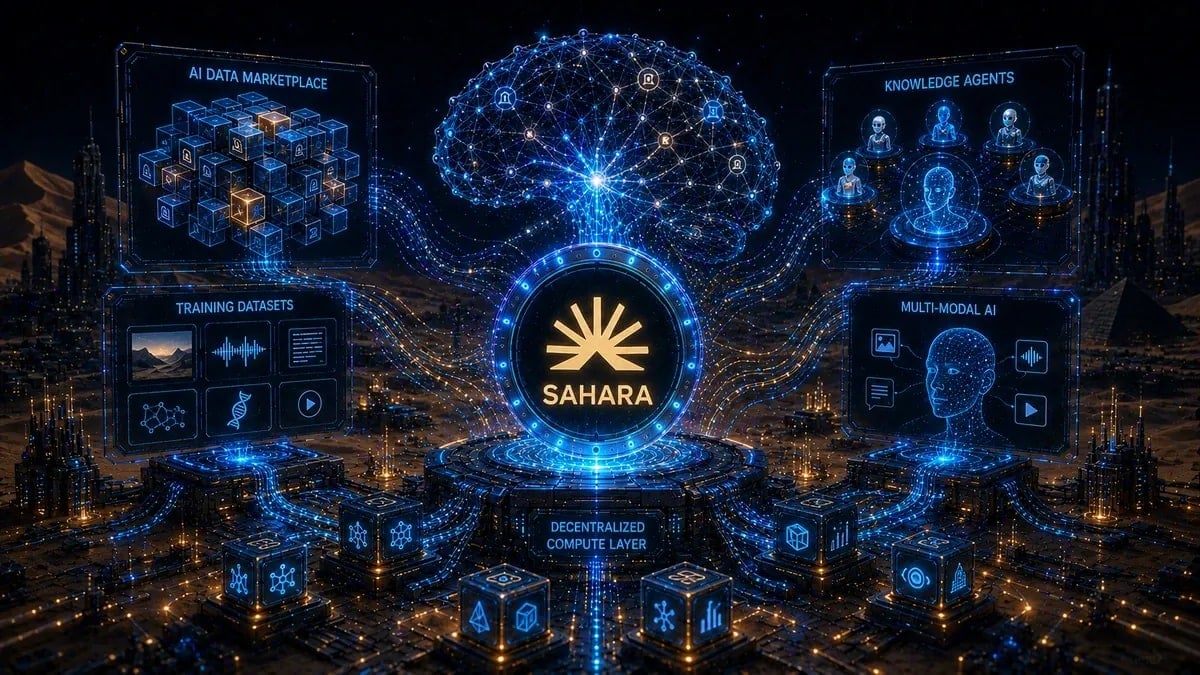
Sahara AI (SAHARA) is a layer one blockchain built specifically for decentralized artificial intelligence development. This 2026 guide covers founders Sean Ren and Tyler Zhou, the $49M raise from Pantera, Binance Labs, Polychain and Sequoia, partnerships with Microsoft, Amazon, MIT and Snap, the Data Services Platform, the AI Developer Platform with no code agent builder, the Decentralized AI Marketplace, SAHARA tokenomics and how Sahara compares against Bittensor, ai16z, MyShell and Ocean Protocol.
What Is Sahara AI (SAHARA)? Decentralized AI Blockchain Guide 2026
Most of the artificial intelligence the world uses every day flows through a tiny number of cloud providers, a handful of model labs, and a centralized stack that decides what data is collected, who labels it, what models are trained, where inference runs, and how the economics are distributed. Sahara AI was built to challenge that arrangement at the protocol layer. It is a layer one blockchain designed from the ground up for decentralized artificial intelligence, with native primitives for data ownership, agent deployment, model marketplaces, and a native utility token called SAHARA that ties the system together.
Founded in April 2023 by Sean Ren, a tenured professor at the University of Southern California and a long time AI researcher, alongside Tyler Zhou, a former Binance Labs investor with deep crypto distribution experience, Sahara raised more than forty nine million dollars across a seed and Series A from Pantera Capital, Binance Labs, Polychain, Sequoia Capital, and a roster of other top tier crypto and traditional venture firms. By 2026 the team had announced collaborations and pilots with Microsoft, Amazon, MIT, and Snap, becoming one of the most institutionally backed decentralized AI projects in the market.
This evergreen guide explains in plain language what Sahara AI is, how the protocol is architected across its Data Services Platform, AI Developer Platform, and Decentralized AI Marketplace, what the SAHARA token actually does, how it compares to other decentralized AI plays like Bittensor, ai16z, MyShell, and Ocean Protocol, and what investors and builders should know before allocating capital, time, or data to the ecosystem in 2026.
If you have wondered what Sahara AI is in practical terms, where the SAHARA token actually accrues value, and whether its decentralized AI promise is more than marketing, this guide is structured to answer those questions with data on the table.
Featured Snippet
Sahara AI is a layer one blockchain built specifically for decentralized artificial intelligence development, founded in April 2023 by USC professor Sean Ren and former Binance Labs investor Tyler Zhou. It raised over forty nine million dollars from Pantera, Binance Labs, Polychain, and Sequoia, and has announced collaborations with Microsoft, Amazon, MIT, and Snap. The protocol combines three core stacks, a Data Services Platform for data labeling and contribution, an AI Developer Platform for no code agent and model creation, and a Decentralized AI Marketplace for monetizing models, datasets, and agents. The SAHARA token is the native utility asset used for inference payments, data provider rewards, agent deployment fees, and on chain governance.
Sahara AI is not another wrapper around a centralized model API. It is an attempt to rebuild the entire AI value chain, from data collection through model training, inference, and agent deployment, as a permissionless protocol with verifiable ownership and on chain economics. That places it in direct conversation with projects like Bittensor and its TAO subnet architecture, ai16z and its ElizaOS agent framework, and MyShell and its SHELL ecosystem of consumer AI agents.
Sahara is built as a sovereign chain rather than a contract deployed on Ethereum or Solana, meaning the team has chosen to optimize the underlying runtime for AI workloads instead of bolting AI on top of a general purpose blockchain. That design choice has consequences for performance, tooling, and developer experience that we will unpack throughout this guide.

The Founding Story Behind Sahara AI
Sahara AI was incorporated in April 2023, at a moment when generative AI had just exited research and entered global consumer use through ChatGPT. Sean Ren, the company's chief executive, is an associate professor of computer science at the University of Southern California where he has led research in natural language processing and knowledge representation, and worked with industry partners including Snap, Amazon, and major Asian technology firms. He is not a typical crypto founder. He is an AI researcher who concluded, after years of looking at how the data economy was structured, that the entire pipeline needed a permissionless redesign.
Tyler Zhou, the cofounder and chief operating officer, brings the crypto half of the formula. Before Sahara he worked at Binance Labs, the venture investing arm of the world's largest crypto exchange, where he evaluated early stage protocols and built relationships with the operators who define listing flow and ecosystem distribution. The combination of Ren's academic credibility and Zhou's crypto network helped Sahara command institutional trust unusual for a new layer one chain.
That credibility translated into capital quickly. Sahara closed a seed round of approximately six million dollars in 2023, followed by a Series A of forty three million dollars announced in August 2024, bringing total disclosed funding to roughly forty nine million dollars. The Series A was led by Pantera Capital, Binance Labs, Polychain Capital, and Sequoia Capital, with participation from additional crypto and traditional technology investors. By 2025 and into 2026, Sahara had also announced or expanded collaborations with Microsoft on enterprise integration work, Amazon on cloud and inference infrastructure, MIT on academic data partnerships, and Snap on consumer facing AI experiences. These collaborations matter less for direct revenue and more for what they signal, since a new chain attempting to host an AI economy needs both crypto native distribution and traditional enterprise validation.
The Three Core Stacks of the Sahara Protocol
To understand Sahara AI as a system rather than a marketing pitch, it is useful to break the protocol into the three primary stacks the team has built and the way each one connects to the others. These are the Data Services Platform, the AI Developer Platform, and the Decentralized AI Marketplace. Together they form the end to end pipeline that the protocol is designed to support, from raw data on the input side through deployed models and agents on the output side.
The Data Services Platform, commonly abbreviated as DSP, is where data contributors, annotators, and curators participate in producing the training inputs that downstream models depend on. In the centralized AI world, this work is often performed through opaque labeling firms or platforms that pay annotators a fraction of the value the resulting datasets eventually generate. The DSP is built to make those contributions verifiable on chain, attributable to specific contributors, and remunerated in SAHARA tokens. Contributors complete labeling tasks, data collection campaigns, or curation jobs, and receive on chain proof of contribution that ties their future rewards to the use of the datasets they helped build.
The AI Developer Platform sits at the next layer and is targeted at builders rather than data providers. The platform is designed as a no code and low code environment that allows developers, and increasingly non technical creators, to define agents and lightweight models without writing reams of training infrastructure code. Builders can connect to datasets sourced through the DSP, specify the behavior of an agent in a guided interface, deploy that agent to the chain, and then monetize it through the marketplace layer. For anyone who has followed our explainer on how AI agents work in crypto, this is recognisably the same primitive that ai16z, MyShell, and similar protocols are building, but with a more vertically integrated stack underneath.
The Decentralized AI Marketplace is the surface where the assets produced by the previous two layers actually meet end users and integrators. Datasets, trained models, and deployed agents are listed in the marketplace with on chain pricing, usage records, and attribution. When a consumer or another protocol uses an agent or queries a model, the inference call settles in SAHARA tokens, and the protocol distributes value among the model deployer, the data contributors whose work fed the model, and the network that secures the transaction. This is the mechanism through which the system aims to keep economic value flowing back to the participants whose data and labor produced it, rather than concentrating it in a single platform.
A Closer Look at the Data Services Platform
The DSP is the layer that operationalizes the protocol's claim that data ownership and contributor compensation should be on chain rather than opaque, and it is the layer where the bulk of the project's early consumer traction has happened. The platform supports several categories of work, including data collection, data annotation, data validation, and longer running curation tasks. A new user creates a wallet, signs into the DSP, and is presented with a queue of available tasks calibrated to their reputation and language profile. Tasks can range from labeling images and transcribing audio for ASR datasets through evaluating the outputs of language models for safety and quality. As work is completed, the platform issues on chain attestations that anchor each contribution to its wallet and feed the reward distribution logic.
From an economic perspective, the most interesting feature is that contributors are not paid purely at task completion. A portion of compensation flows over time, tied to the downstream usage of the datasets they helped create. If a dataset that included a contributor's labeling work is licensed to a builder who deploys a profitable agent, the protocol routes a share of that recurring revenue back to the original contributors through on chain attribution. In effect, the DSP attempts to convert what is traditionally a flat fee gig economy into an ownership economy with continuing royalties. Whether this model holds up at scale is an open question, since distinguishing high quality contributions from spam, deduplicating contributors across wallets, and preserving privacy are problems even centralized labeling firms have not fully solved.
The AI Developer Platform and the No Code Agent Builder
The AI Developer Platform is the second pillar of the Sahara stack and the part of the project most likely to drive consumer and prosumer adoption in 2026 and beyond. Rather than expecting developers to assemble training pipelines, manage GPU clusters, and write boilerplate to deploy a model or agent, the platform offers a guided, mostly visual interface for creating AI agents that can be deployed directly to the Sahara network. The design philosophy is closer to a modern SaaS no code builder than to a traditional machine learning notebook.
Inside the builder, a creator defines an agent by selecting a base model, attaching context sources such as datasets from the DSP or external knowledge bases, defining the agent's behavior through prompts and rules, and configuring how the agent should respond to specific kinds of input. The interface guides the creator through testing the agent against representative queries before deployment. Once the creator is satisfied, the agent is deployed to the Sahara network with a single action, gets a unique on chain identifier, and is listed in the marketplace where users can interact with it and pay in SAHARA tokens.
For builders who are familiar with frameworks like ElizaOS on Solana through ai16z, or MyShell's app builder, the Sahara experience will feel structurally similar but more integrated. The advantage of the integration is that everything from the dataset that grounds the agent, through the inference payment, through the on chain reward to data contributors, lives on a single chain with a single token. The cost of that integration is that builders who want to bring their own existing model and treat Sahara purely as an inference endpoint have a less flexible experience than they would have on a horizontally specialized AI inference network.

The no code positioning is deliberate. Sahara is targeting the next several million users who want to build AI agents for their businesses or content workflows without learning Python, PyTorch, or model deployment ops. If the protocol serves those users credibly, it generates a flywheel of agents, which drives inference demand, which funds contributor rewards, which improves dataset quality, which improves the agents. Whether that flywheel spins at the needed pace is, like every protocol level bet, an open question the next two to three years will answer in public.
The Decentralized AI Marketplace as the Settlement Layer
The third stack, the Decentralized AI Marketplace, is best understood as the settlement and discovery layer for everything produced upstream. Datasets, models, and agents become discoverable, priceable, usable, and monetizable. The marketplace lists assets with verifiable provenance, displays their on chain usage history, and provides the interfaces through which consumers and protocols pay to use them. Every transaction settles in SAHARA tokens and routes value back across the contributor stack according to programmed rules.
From a builder perspective, the marketplace is also a distribution channel. Once an agent is deployed via the AI Developer Platform, the builder does not need to bring their own audience. The marketplace surfaces new agents, ranks them by usage and quality signals, and offers them to users browsing for AI tools, similar to what an app store does for mobile developers, with the additional property that revenue accrues directly to the on chain wallet of the deployer and the upstream contributors. Pricing can be configured per inference, per subscription, or as a one time licensing fee for premium datasets, and the protocol enforces the payment logic on chain without requiring a centralized payments processor.
The SAHARA Token and Its Role in the Economy
The SAHARA token is the native utility asset that ties the three protocol layers together. Like most well designed network tokens, it serves a small number of clear functions rather than trying to do everything at once. Those functions break down into four primary categories, namely payment for AI inference and agent usage, rewards for data providers and other ecosystem contributors, fees for deploying agents and listing assets on the marketplace, and on chain governance over the parameters and treasury of the protocol.
As an inference payment asset, SAHARA functions in much the same way that gas functions on a general purpose blockchain. When a user calls an agent deployed on Sahara, the call costs a small amount of SAHARA which is paid by the user, captured by the network, and distributed to the agent deployer and the upstream contributors. For protocols and applications that integrate Sahara agents into their own products, SAHARA becomes the natural unit of account for AI usage costs, and high volume integrators may hold treasury balances of the token to fund those costs on an ongoing basis.
As a reward asset, SAHARA flows in the opposite direction. Contributors who complete tasks on the DSP, validators who secure the chain, builders who deploy successful agents, and ecosystem participants who provide other services all earn SAHARA over time. The dual role as payment unit and reward unit is what creates the protocol's economic loop. Demand for inference and agents creates buying pressure for the token, while supply emissions to contributors create the labor that produces the value those agents and datasets generate.
SAHARA also serves as the governance asset. Holders can vote on protocol upgrades, parameter changes, treasury allocations, and other decisions that the team has chosen to put under decentralized control. As the protocol matures, governance over things like fee splits, validator economics, and grant programs becomes increasingly meaningful, and SAHARA holders are the constituency that exercises that control. If you are not yet familiar with how on chain governance works mechanically, our broader explainer on DeFi and on chain governance fundamentals covers the underlying primitives that Sahara reuses.
From a token standard perspective, SAHARA is issued natively on the Sahara chain rather than as an ERC 20 token on Ethereum, although wrapped representations may exist on other chains for DeFi integrations. Serious holders generally keep long term positions on a hardware wallet rather than on an exchange.
SAHARA Tokenomics and Distribution
The exact circulating supply, total supply, and emission schedule for SAHARA are published by the team and indexed on standard analytics venues such as CoinMarketCap and DEXTools. The headline structure follows a familiar pattern for well capitalized layer one tokens, with allocations to the team and early investors under multi year vesting cliffs, a foundation and treasury allocation for development, a community and contributor allocation that flows through the DSP and ecosystem programs, and an allocation reserved for liquidity, exchange listings, and market making.
For investors, the two most important questions are the unlock schedule and the share of supply controlled by insiders. SAHARA's structure includes meaningful long term vesting for the team and investor allocations, which is what you would expect from a protocol backed by Pantera, Binance Labs, Polychain, and Sequoia. For several years post launch, unlocks are an ongoing headwind the protocol has to absorb through real usage and demand, which is the norm for the category and the single most important supply side variable to track. On the demand side, buying pressure comes from inference payments, agent deployment fees, marketplace listing fees, and broader ecosystem demand. The healthy trajectory is one in which the value of inference and agent activity rises faster than the pace of supply unlocks, and holders should track weekly active agents, inference call volume, dataset licensing activity, and DSP contributor counts to assess that trajectory.
Sahara Compared With Bittensor, ai16z, MyShell, and Ocean Protocol
To place Sahara correctly inside the decentralized AI landscape, it helps to compare it directly with four other projects that occupy adjacent corners of the same category. None of these comparisons are price predictions. They are positioning maps that show where Sahara overlaps and where it diverges.
Bittensor (TAO) is the largest and oldest decentralized AI network and is structurally very different from Sahara. Bittensor is organised around the concept of subnets, each of which competes to provide a specific AI service such as text generation, image generation, or scientific data extraction, with miners producing outputs and validators scoring their quality. TAO is the native token rewarded to high performing participants. Bittensor focuses on the supply side of intelligence, namely how to coordinate distributed compute and models to produce useful outputs. Sahara, by contrast, focuses on the full vertical from data through agents through marketplace, including the consumer surface. Our deep dive on Bittensor and how its subnets work contrasts the two design philosophies in detail.
ai16z and ElizaOS represent the agent framework axis of decentralized AI. ai16z is a Solana based community fund and the steward of the open source ElizaOS agent framework, which has become one of the most widely deployed agent stacks in crypto, with thousands of agents built by independent developers. Sahara overlaps with ai16z in the agent layer, but their positions are different. ai16z is framework first and chain agnostic in spirit, while Sahara is chain first and bundles the agent builder with the data and marketplace layers. Our explainer on ai16z and ElizaOS goes deeper into how their community model compares to a protocol native one.
MyShell (SHELL) is the most direct consumer facing AI competitor to Sahara on the agent and app layer. MyShell ships a polished consumer experience for chatting with, building, and remixing AI characters and apps, with its own native SHELL token. Where Sahara emphasizes the underlying data and marketplace economics, MyShell emphasizes the consumer surface and creator monetization. The two could plausibly coexist as different layers of the same long run stack, but in the present cycle they compete for attention from the same builders. Our coverage on MyShell and its SHELL ecosystem walks through that comparison.
Ocean Protocol is the predecessor on the data side of decentralized AI. Ocean has spent years building primitives for tokenized data assets, data marketplaces, and compute to data privacy preserving workflows. Where Sahara bundles data services into a vertically integrated chain, Ocean has historically built data primitives that other protocols and enterprises can compose with. Ocean's strength is depth on the data infrastructure side, while Sahara's strength is the integrated stack with consumer facing front ends. Our walkthrough of Ocean Protocol and its decentralized data marketplace covers that history.

The most useful way to think about Sahara relative to these peers is that it is the only project in the group attempting to be vertically integrated across data, developer tools, and marketplace on a single chain with a single token. That is an ambitious bet, and it is the reason institutional investors with allocations across multiple decentralized AI plays often hold Sahara as their integrated layer one bet alongside Bittensor as their supply side intelligence bet and ai16z or MyShell as their agent ecosystem bets.
How Sahara Is Built Technically
Underneath the product stack, Sahara is a sovereign layer one chain with a runtime designed for the kinds of workloads that AI applications generate. The team opted for a purpose built execution layer that allows the protocol to optimize for the throughput, storage, and oracle patterns that AI workloads need, rather than treating the chain as a generic Ethereum Virtual Machine clone. Cross chain bridges and wrapped representations on other ecosystems allow SAHARA to participate in broader DeFi liquidity without forcing AI workloads onto less suitable infrastructure.
Consensus on Sahara is delegated proof of stake style, with validators staking SAHARA to participate in block production and earning rewards from network fees and emissions. Holders who do not run validators themselves can delegate their stake to a validator they trust and earn a share of those rewards. If you are new to the underlying mechanics, our explainer on how staking works in crypto covers the primitives that Sahara reuses. SAHARA pairs and wrapped representations are also tracked across the main analytics dashboards. To monitor liquidity, holder distribution, or new pair activity, our walkthrough on how to use DEXTools to monitor tokens and pairs applies directly.
Sahara Timeline From Founding to 2026
Sahara AI is founded by Sean Ren, associate professor at the University of Southern California, and Tyler Zhou, formerly of Binance Labs. The thesis is to build a layer one blockchain specifically for decentralized AI development.
Sahara raises an initial seed round of approximately six million dollars and begins building out the Data Services Platform, recruiting early contributors and dataset partners.
Sahara closes a Series A funding round of forty three million dollars led by Pantera Capital, Binance Labs, Polychain Capital, and Sequoia Capital, bringing total disclosed funding to roughly forty nine million dollars.
Sahara expands the Data Services Platform globally, growing the contributor base across multiple regions and language profiles, while announcing collaborations with major technology and research partners.
The AI Developer Platform launches publicly, opening the no code agent builder to a wider audience. Sahara confirms further enterprise collaborations including work with Microsoft, Amazon, MIT, and Snap on different parts of the stack.
The Decentralized AI Marketplace expands its catalog of agents, models, and datasets, with growing on chain inference volume settling in SAHARA tokens and ecosystem grant programs distributing further tokens to builders.
Sahara is established as one of the most institutionally backed decentralized AI projects in the market, with the SAHARA token tradable on major centralized exchanges and tracked across the main analytics dashboards.
The protocol roadmap emphasizes deepening the marketplace, expanding cross chain integrations, increasing the share of governance under community control, and growing the number of weekly active agents.
Real Use Cases For Sahara Today
Beyond the abstract architecture, it is worth grounding the discussion in the kinds of use cases the protocol supports in production. On the contributor side, individuals and teams around the world use the Data Services Platform to participate in data labeling and curation tasks in exchange for SAHARA tokens. For users in regions where labor markets reward skilled annotation at favorable conversion rates, this has become a meaningful source of crypto native income, and the experience is accessible from a browser, which lowers the barrier to entry compared with running validator infrastructure.
On the builder side, creators use the AI Developer Platform to deploy agents across a range of vertical use cases. Customer support agents for small businesses, content generation agents for creators, research assistant agents for analysts, and gaming and entertainment agents are all categories that have appeared in the marketplace. The shared feature across these examples is that the builder benefits from on chain monetisation without needing to set up payment processing, while the user gets transparent pricing denominated in SAHARA. Enterprise partnerships with Microsoft, Amazon, MIT, and Snap put Sahara primitives in front of audiences that would not otherwise encounter them, functioning as pilots and validation rather than direct revenue commitments.
Real Risks Investors and Builders Should Take Seriously
Sahara is one of the more credible decentralized AI projects in the market, but it carries real risks that investors and builders should weigh honestly. These risks are not unique to Sahara, they are typical of layer one chains targeting emerging verticals, but they apply here and deserve attention.
The first risk is execution. The protocol is attempting to build a vertically integrated stack from data through agents through marketplace, on a sovereign chain, with a single native token. Each of those components is hard on its own, and integrating them is harder still. The team has the funding and the talent to attempt it, but the bar is high, and execution risk over multi year timelines is real.
The second risk is supply pressure from token unlocks. Like every well capitalized layer one, Sahara has team and investor allocations on multi year vesting schedules. As those allocations unlock over time, they create supply that has to be absorbed by genuine demand from inference, agents, and ecosystem activity. Holders should monitor the unlock schedule and the ratio of unlock supply to organic demand as one of the key health metrics for the protocol.
The third risk is competitive. Bittensor, ai16z, MyShell, Ocean Protocol, and a long tail of other decentralized AI projects are all competing for builder mindshare, capital, and end user attention. Sahara's integrated bet is differentiated, but differentiated does not mean dominant by default. The competitive dynamics in decentralized AI through the rest of the decade will determine which projects accrue durable value and which become curiosities.
The fourth risk is operational and security related. As a new layer one chain handling AI assets, the protocol presents an unusual attack surface that includes contract level vulnerabilities, validator economics issues, oracle problems for data attestation, and standard threats that affect any crypto network. Traders and contributors using the protocol from hot wallets are also exposed to phishing, fake airdrops, and contract approval scams. Our walkthrough on how to avoid crypto address poisoning scams is required reading for anyone holding or transacting in SAHARA from a hot wallet.
Sahara AI Pros and Cons at a Glance
PROS
Strong founder profile with USC professor Sean Ren on the AI side and Binance Labs alumnus Tyler Zhou on the crypto side.
Forty nine million dollars in disclosed funding from top tier investors including Pantera, Binance Labs, Polychain, and Sequoia.
Vertically integrated stack spanning data, developer tools, and marketplace on a single sovereign chain.
No code agent builder lowers the barrier for non technical creators to deploy and monetize AI agents.
Enterprise validation through partnerships with Microsoft, Amazon, MIT, and Snap.
CONS
Sovereign chain bootstrap risk including validator decentralization, tooling depth, and developer ecosystem maturity.
Multi year team and investor unlock schedule produces ongoing supply side pressure on the SAHARA token.
Intense competition from Bittensor, ai16z, MyShell, Ocean Protocol, and other decentralized AI projects.
Execution risk across a complex vertically integrated stack that must deliver on all three layers to succeed.
Operational risks including smart contract bugs, validator misbehavior, and phishing targeting active users.
Best Practices For Anyone Engaging With Sahara
If, after weighing the architecture, the team, the funding, and the risks, you decide to participate in Sahara as a contributor, builder, or investor, a few simple rules separate sustainable participation from improvised gambling. None of this is investment advice. It is operational hygiene.
Size positions assuming meaningful drawdowns are possible. SAHARA is a relatively new layer one token in an emerging vertical, and even high quality protocols in this category have experienced sixty to eighty percent drawdowns from local highs during broader market corrections. Treat any SAHARA position as part of a diversified risk budget, not as the centerpiece of a portfolio. Verify the contract address every single time, since imposter SAHARA tokens have circulated across multiple chains, especially after major exchange listings. Always reference the official token contract listed on the project's site, on the verified DEXTools page, and on at least one major analytics dashboard before approving any swap, following the workflow in our walkthrough on verifying tokens and pairs on DEXTools.
Use a dedicated trading wallet for active SAHARA trading or DSP contributions, separate from your long term holdings. Hardware wallets remain the right home for size positions, with hot wallets used only for day to day activity. Track health metrics rather than the price ticker alone, including weekly active agents on the marketplace, inference call volume settling in SAHARA, contributor count and retention on the DSP, dataset licensing activity, validator decentralization, and the ratio of token unlocks to organic demand. Plan exits before you enter, with a partial take profit ladder, a stop level you will not override during drawdowns, and a maximum position size as a share of total portfolio.
Frequently Asked Questions About Sahara AI
1. What is Sahara AI in one sentence?
Sahara AI is a layer one blockchain built specifically for decentralized artificial intelligence development, combining a Data Services Platform, an AI Developer Platform, and a Decentralized AI Marketplace under a single native token called SAHARA.
2. Who founded Sahara AI and when?
Sahara AI was founded in April 2023 by Sean Ren, associate professor of computer science at the University of Southern California and a long time AI researcher, and Tyler Zhou, who previously worked at Binance Labs as a crypto investor.
3. How much funding has Sahara raised and from whom?
Sahara has raised approximately forty nine million dollars across a seed round and a Series A. Lead investors include Pantera Capital, Binance Labs, Polychain Capital, and Sequoia Capital, with additional participation from a long list of other crypto and traditional venture firms.
4. What does the SAHARA token actually do?
SAHARA is the native utility token of the Sahara chain. It is used to pay for AI inference and agent usage, to reward data contributors and ecosystem participants, to pay deployment and listing fees on the marketplace, and to vote in on chain governance decisions about the protocol.
5. What are the three core platforms of Sahara?
The three core platforms are the Data Services Platform for data contribution and labeling, the AI Developer Platform for no code agent and model creation, and the Decentralized AI Marketplace for listing, discovering, and monetizing datasets, models, and agents.
6. How does Sahara compare to Bittensor?
Bittensor is organized around subnets in which miners and validators compete to provide specific AI services, focusing on the supply side of intelligence. Sahara is vertically integrated across data, developer tools, and marketplace on a single chain with a single token. They occupy different positions in the decentralized AI stack and many institutional investors hold both as complementary bets.
7. How does Sahara compare to ai16z and MyShell?
ai16z stewards the open source ElizaOS agent framework and operates as a community fund on Solana, while MyShell focuses on a polished consumer surface for chatting with and building AI characters under its SHELL token. Sahara differs by being a sovereign layer one with an integrated data, developer, and marketplace stack rather than a framework or a consumer app.
8. How does Sahara compare to Ocean Protocol?
Ocean Protocol has spent years building primitives for tokenized data assets, data marketplaces, and privacy preserving compute to data flows that other protocols and enterprises can compose with. Sahara bundles data services into a vertically integrated chain alongside the developer and marketplace layers, prioritizing integration over composability.
9. What partnerships does Sahara have with traditional tech companies?
Sahara has announced collaborations with Microsoft on enterprise integration work, Amazon on cloud and inference infrastructure, MIT on academic and research partnerships, and Snap on consumer facing AI experiences. These collaborations function as pilots, integrations, and validation rather than direct revenue commitments.
10. Can anyone contribute data to Sahara and earn SAHARA tokens?
Yes. The Data Services Platform is open to contributors who create a wallet, sign in to the platform, and complete tasks calibrated to their reputation and language profile. Tasks range from labeling and annotation through validation and curation, with rewards paid in SAHARA tokens and additional value flowing over time as the datasets they contributed to are used downstream.
11. What are the main risks of holding SAHARA?
Main risks include execution risk on a complex vertically integrated stack, supply pressure from multi year team and investor unlocks, competition from Bittensor, ai16z, MyShell, Ocean, and other decentralized AI projects, and operational risks for active users including phishing, address poisoning, and impostor contracts. SAHARA also exhibits volatility characteristic of new layer one tokens.
12. Is SAHARA a good investment in 2026?
SAHARA is a high conviction bet on the thesis that decentralized AI infrastructure will accrue durable value, paired with the execution risk of a new vertically integrated layer one. Whether it suits any specific person depends on risk tolerance, time horizon, position sizing, and overall portfolio context. It can be appropriate as part of a diversified decentralized AI allocation for investors who understand the category. It is not appropriate as a core long term holding for risk averse investors. This guide is informational and not financial advice.
Final Thoughts On Sahara AI Heading Into 2026 And Beyond
Sahara AI is one of the more serious attempts in this cycle to translate the abstract idea of decentralized artificial intelligence into a concrete product stack with real users, real builders, and real economic flows. Its founders combine the academic credibility of a USC professor with the crypto distribution experience of a Binance Labs alumnus. Its capital base is among the deepest in the category. Its product surface, spanning data services, a no code agent builder, and a marketplace, is broader and more vertically integrated than most of its peers.
For new investors approaching the SAHARA token in 2026, the right frame is neither cynicism nor evangelism. Sahara is a layer one chain attempting one of the most ambitious vertically integrated bets in decentralized AI, and the outcome of that bet will be visible over multi year timelines rather than in single quarter price action. The metrics that matter are usage on the platforms, the health of the contributor base, the volume of inference settling on chain, the pace of agent deployment, and the balance between supply emissions and organic demand. Track those numbers, size positions inside a sensible portfolio budget, verify contracts, secure wallets, and treat the project as exactly what it is, namely a real and credible attempt to rebuild the AI economy on permissionless rails with a long road still ahead.
Related Guides
- Tezos (XTZ) Explained: Self-Amending Blockchain
- Sui Network Architecture: Object-Centric Design, Parallel Execution and DeFi Apps (2026)
- What Is Sui? Move-Based L1 and SUI Guide 2026
- What Is Stellar (XLM)? Cross-Border Payments Guide
- How Blockchain Sharding Works: Parallelization, Throughput and Design Tradeoffs (2026)