Bridge Hacks: Lessons from Ronin, Wormhole, and Nomad

Blockchain bridges hold billions in static token escrows, turning them into prime cybercriminal targets. We break down the validator key thefts and smart contract bugs behind historic exploits.
The Multi-Billion Dollar Honey Pots: Why Bridges Are Targeted
- In decentralized finance, capital naturally gravitates toward efficiency. As alternative Layer 1 chains and Layer 2 rollups multiplied, blockchain bridges became the essential infrastructure routing billions of dollars in liquidity across isolated networks. However, to facilitate a smooth user experience, classic "lock-and-mint" bridges must maintain massive, static pools of native tokens locked in smart contract escrows on their source chains.
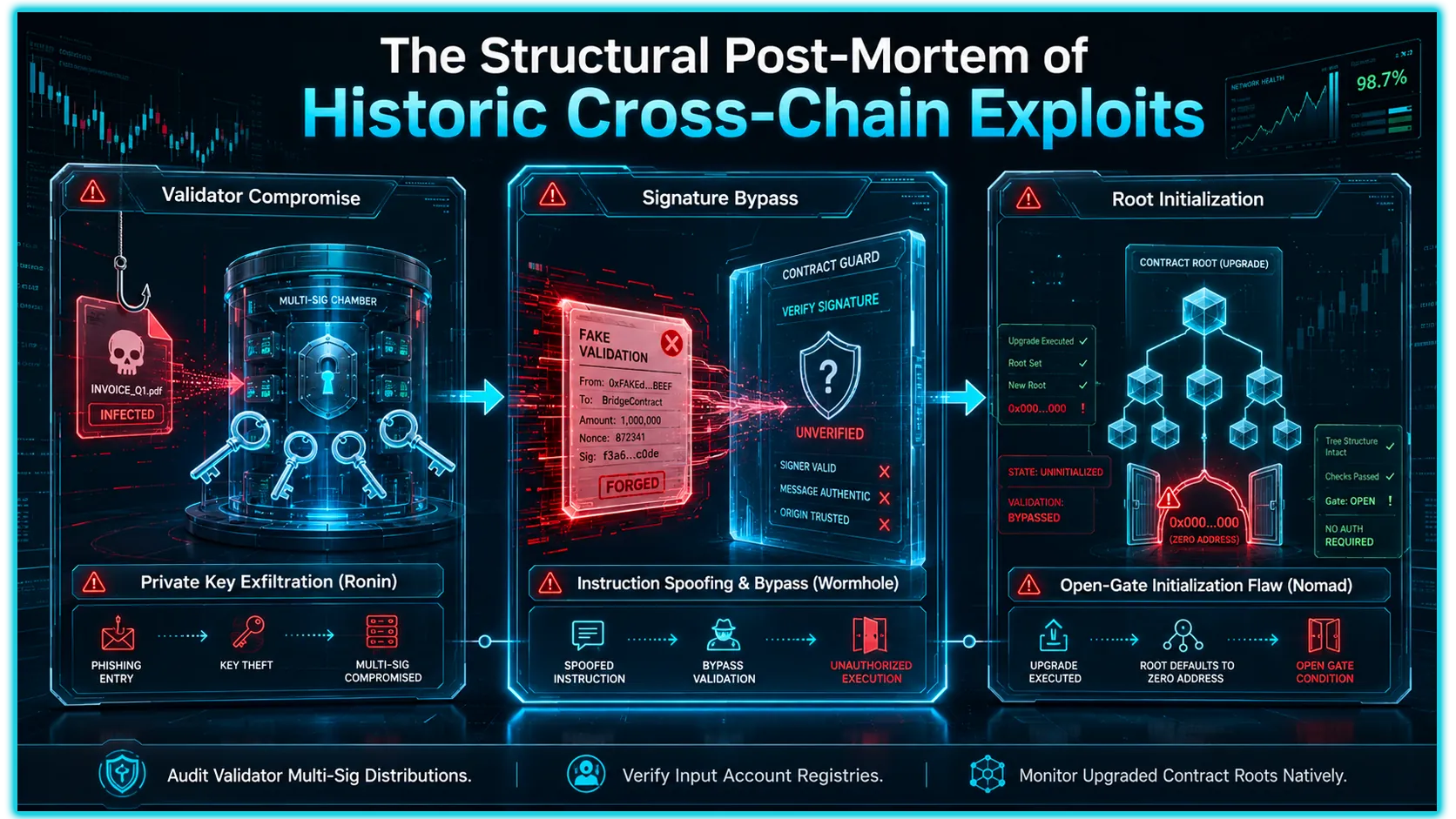
- This architectural concentration of capital created the ultimate Web3 honey pot. To an advanced cybercriminal group, targeting an individual DeFi user or even a single decentralized application yields nominal returns; by contrast, compromising a cross-chain bridge opens the gate to an entire network's underlying collateral pool. The history of cross-chain security is defined by three landmark exploits (Ronin, Wormhole, and Nomad) each exposing distinct, catastrophic vulnerabilities across social engineering, smart contract logic, and initialization upgrades.
The Date: March 2022
The Damage: ~$624 Million
The Vector: Social Engineering & Validator Key Exfiltration
The Mechanics of the Exploit
- The Ronin Network, an Ethereum sidechain built explicitly for the Axie Infinity gaming ecosystem, relied on a seemingly secure 9-node cryptographic multi-signature matrix. To authorize an asset withdrawal from the Ethereum escrow bridge, a transaction required valid cryptographic signatures from a simple majority: 5 out of the 9 validators.
- The Lazarus Group bypassed the blockchain's cryptographic defenses by targeting human infrastructure. Using a sophisticated spear-phishing campaign on LinkedIn, the attackers posed as recruiters, tricking a senior engineer at Sky Mavis into downloading a malicious "job offer" PDF file during an interview process. The spyware infiltrated the company's network, allowing the hackers to exfiltrate the private keys of 4 validators controlled directly by Sky Mavis.
- To secure the final 5th key needed for consensus quorum, the hackers tapped into a legacy tracking allowance: Sky Mavis had previously been granted permission to sign transactions on behalf of the independent Axie DAO validator node. Though that arrangement was discontinued, the access rights had never been revoked from the server whitelist. The attackers accessed the backdoor, gathered the 5th signature, and completely drained the bridge contract.
The Core Lesson
A multi-signature framework is only as decentralized as its physical infrastructure footprint. If a single corporate entity holds or influences the majority of the validating keys on a single server setup, the system behaves exactly like a vulnerable, centralized database. Multi-sig protocols require strict geographic separation, multi-vendor hardware configurations, and automatic revocation parameters for historical access rights.
2. The Wormhole Hack: The Input Account Injection Bypass
The Date: February 2022
The Damage: ~$326 Million
The Vector: Smart Contract Logic & Account Spoofing
The Mechanics of the Exploit
- The Wormhole protocol bridges assets by relying on its 19 Guardian nodes to attest to source-chain transfers. On the Solana side of the network, the bridge logic utilizes a built-in system program called the
sysvarregistry to verify that the Guardian signatures match the state history accurately.
- The hacker unmapped this verification gate by identifying a flaw in Solana's account validation parameters. The attacker crafted a custom, malicious smart contract account that perfectly mimicked the data structure of the official
sysvarprogram. During the instruction call, the hacker injected this fraudulent account address into the bridge'sverify_signaturesfunction.
- Because the Wormhole contract code failed to include an explicit lookup command confirming that the incoming
sysvaraddress was the authentic, system-native address, the contract accepted the spoofed data as true. The fake program reported that the 19 Guardians had successfully signed off on a massive deposit that never actually occurred, prompting the bridge to instantly mint 120,000 wrapped Ethereum (wETH) out of thin air on Solana, which the hacker rapidly extracted.
The Core Lesson
Smart contracts running on high-throughput, account-based execution layers cannot afford to trust unverified inputs. Every external contract account, oracle address, and system variable passed into a function must be rigorously validated against an immutable code whitelist. Input verification failures represent some of the most capital-destructive bugs in Web3 history.
3. The Nomad Bridge: The "Decentralized Looting" Initialization Flaw
The Date: August 2022
The Damage: ~$190 Million
The Vector: Smart Contract Configuration Upgrades
The Mechanics of the Exploit
- Nomad operated as an optimistic cross-chain bridge where transactions were processed under the assumption of validity unless challenged by watchers during a time-gated window. The platform utilized a replica smart contract to track and store the historical roots of all proven messages.
- The vulnerability was introduced during a routine protocol code upgrade. When the development team initialized the updated replica contract, they accidentally set the trusted default root value configuration parameter to
0x00(the blank zero-address hash).
- This simple mistake turned the bridge's security gate into an open vault. Because the contract script read
0x00as an automatically trusted and validated state, any transaction message that had not yet been proven (including completely fake withdrawal claims) was instantly processed as valid.
- Once the initial hacker discovered the flaw, the exploit leaked to the public. Because the attack did not require sophisticated programming tools, hundreds of copycat bots and retail web users simply copied the original hacker's transaction data using basic block explorers, swapped out the recipient wallet address for their own, and participated in a chaotic, decentralized looting of the bridge pool within hours.
The Core Lesson
Smart contract upgrades are highly volatile events that can instantly invalidate previously secure assumptions. Setting a default configuration parameter to a zero-address state can inadvertently strip out validation logic entirely. All mainnet contract initializations demand automated regression testing frameworks and strict multi-stage staging reviews to confirm that updates do not accidentally disable vital access-control guardrails.
Historical Cross-Chain Exploits Matrix
| Protocol | Exploit Target Vector | Core Operational Failure |
| Ronin | Social Phishing | Centralized Key Management |
| Wormhole | Account Injection | Missing Input Validation |
| Nomad | Upgrade Initialization | Zero-Root Default Setting |
Universal Market Telemetry Sourcing via DEXTools
- As cross-chain architectures rebuild their defensive layers and migrate toward intent-based frameworks or zero-knowledge scaling systems, tracking real-time asset flows, token capitalizations, and the pool depths of wrapped tokens remains an indispensable risk management practice. Sourcing analytics through advanced decentralized charting architectures like DEXTools gives market participants an essential universal platform to monitor live token behaviors, evaluate pool depths, and inspect contract parameters across all public execution networks.
- By leveraging core features like the Pair Explorer, Live New Pairs dashboard, and the integrated Trade Story or Top Traders diagnostic tools, technical traders can seamlessly audit localized volume trends, track large whale wallet capital reallocations via the Big Swap Explorer, and check automated contract safety scores before initiating any on-chain interactions, ensuring your hardened hardware setup interacts safely with verified market venues.
You can access DEXTools here and start trading today!
Disclaimer: This article is for informational purposes only and does not constitute investment advice, financial advice, trading advice, or any other kind of advice. DEXTools does not recommend buying, selling, or holding any cryptocurrency or token. Users should conduct their own research and consult with a qualified financial advisor before making any investment decisions. Cryptocurrency investments are volatile and high-risk. DEXTools is not responsible for any losses incurred.