How to Build a No-Trade List Using DEXTools
— By Whatsertrade in Tutorials

Learn how to build a crypto no-trade list using DEXTools to avoid weak tokens, risky setups, bad liquidity, and emotional entries.
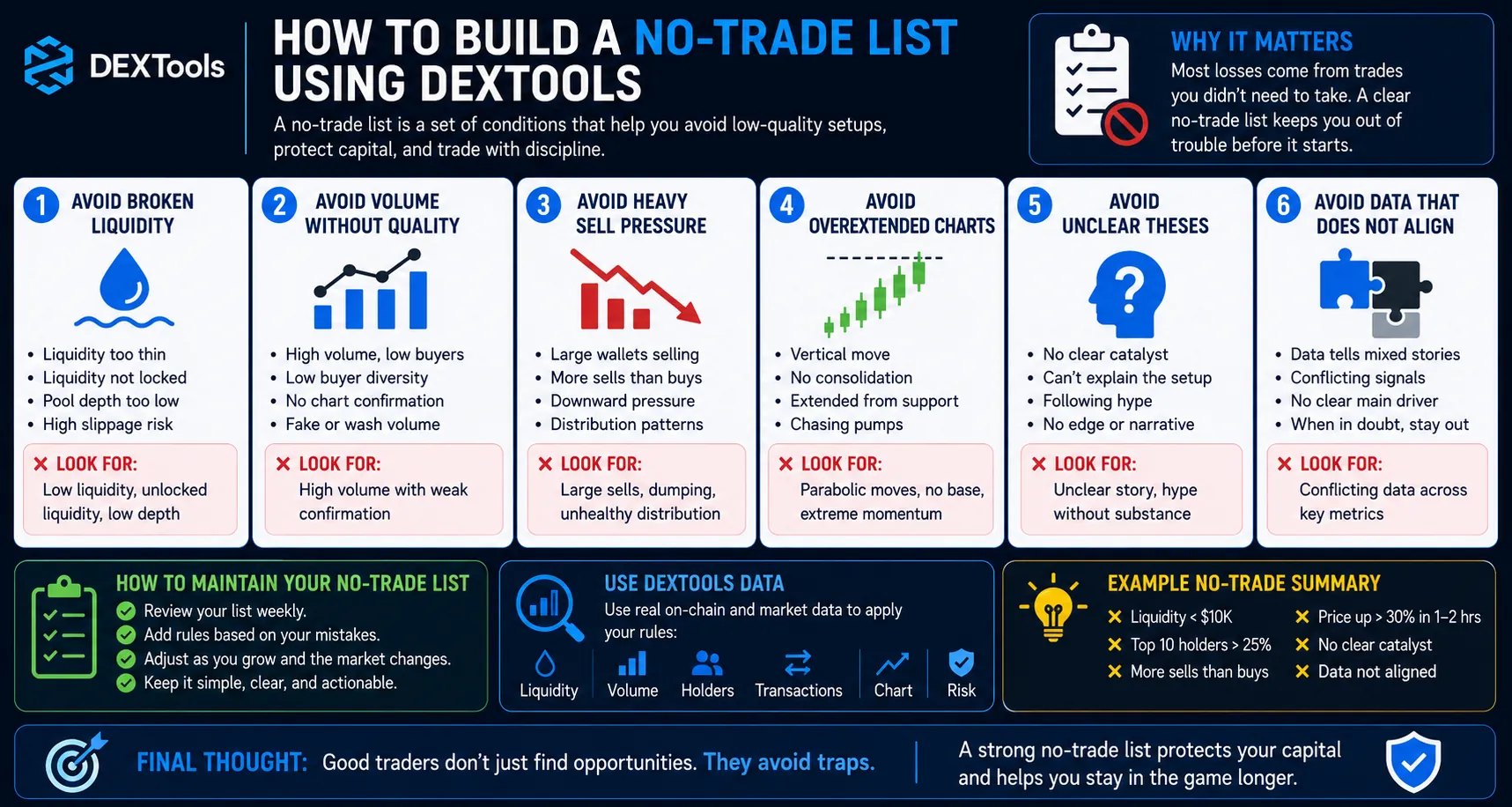
Most trading tutorials focus on finding tokens to buy. But one of the most powerful skills in crypto is knowing what not to trade.
A no-trade list is a personal list of conditions that automatically make you avoid a token. It protects you from emotional decisions, weak setups, and repeated mistakes.
Key Takeaways
- What Is a No-Trade List?
- Rule 1: Avoid Broken Liquidity
- Rule 2: Avoid Volume Without Quality
- Rule 3: Avoid Heavy Sell Pressure
- Rule 4: Avoid Overextended Charts
- Rule 5: Avoid Unclear Theses
Using DEXTools, traders can build a no-trade list based on real market data instead of fear or guesswork.
What Is a No-Trade List?
A no-trade list is not a list of specific tokens. It is a list of conditions that tell you when to stay out.
For example:
Do not trade tokens with extremely weak liquidity.
Do not trade tokens where large wallets are selling aggressively.
Do not trade tokens with suspicious transaction patterns.
Do not trade tokens that have already moved too far without consolidation.
Do not trade tokens you cannot explain clearly.
The goal is to remove bad trades before they reach your buy button.
Rule 1: Avoid Broken Liquidity
Liquidity is one of the clearest reasons to avoid a token.
Add this to your no-trade list:
“I will not trade tokens where liquidity is too thin, unstable, or clearly insufficient for the current volume.”
Weak liquidity can make entry look easy but exit difficult. DEXTools helps you check whether the pool can support real trading.
Rule 2: Avoid Volume Without Quality
High volume can look attractive, but not all volume is meaningful.
Add this rule:
“I will not trade tokens where volume is high but buyer diversity, liquidity, and chart structure do not confirm real demand.”
Volume should be supported by other data. If it stands alone, it may be noise.
Rule 3: Avoid Heavy Sell Pressure
The transaction feed can show when a token is under pressure.
Add this rule:
“I will not trade tokens where large wallets are repeatedly selling into buyer interest.”
A token can still pump during sell pressure, but the risk is higher. If sellers dominate the market, patience is better than hope.
Rule 4: Avoid Overextended Charts
Buying late is one of the most common mistakes in DEX trading.
Add this rule:
“I will not buy a token after a vertical move unless the market forms a clear new structure.”
A green chart is not always an opportunity. Sometimes it is a warning that the easy move already happened.
Rule 5: Avoid Unclear Theses
If you cannot explain why a token is worth watching, you probably should not trade it.
Add this rule:
“I will not trade a token unless I can explain the setup in one sentence.”
This protects you from random entries and social media influence.
Rule 6: Avoid Data That Does Not Align
Sometimes metrics disagree. That does not always mean avoid, but it means slow down.
Add this rule:
“I will not trade when liquidity, volume, holders, transactions, and chart structure tell conflicting stories and I cannot identify the main driver.”
Confusion is a valid reason to wait.
How to Maintain Your No-Trade List
Review your no-trade list weekly. Add rules based on mistakes you keep repeating.
If you often buy too late, add stricter chart rules. If you often ignore liquidity, add liquidity limits. If you chase hype, add a thesis rule.
Your no-trade list should evolve with your experience.
Final Thoughts
A no-trade list is a discipline tool. It helps traders protect capital by avoiding setups that do not meet their standards.
DEXTools provides the data to build that list: liquidity, volume, transactions, holders, chart structure, and risk indicators.
Good traders do not only find opportunities. They avoid traps.
Sometimes the best trade is the one your no-trade list keeps you from taking.
How to Check a Liquidity Pool Before Buying a Token The Whale Shadow: How Large Wallets Distort Retail Interpretation on DEX Charts When Not to Trade: 12 Red Flags Every DeFi Trader Should Know Fake Volume vs Real Demand: How to Spot Artificial Momentum in DeFi Trading