Seed Phrase Explained: 12 vs. 24 Words and Best Practices

Self-custody eliminates the banking gatekeeper but transfers absolute security responsibility straight to you. We break down the cryptographic math spaces and steel backup tactics needed to protect your master phrase.
The Root Matrix of Self-Custody: Eliminating the Human Counterparty
- In the legacy financial ecosystem, ownership is an illusion managed by centralized databases. When you deposit capital into a traditional bank account, you do not own the physical cash; you own a unsecured claim against the banking institution. The bank tracks your identity through a government-issued passport, manages your account visibility behind closed operational doors, and issues temporary passwords that can be overridden, reset, or frozen by corporate executive decree at any moment. This configuration forces you to accept total dependency on a centralized counterparty.
- Decentralized blockchain networks systematically dismantle this dependency using mathematical self-custody. On an open, peer-to-peer ledger, your assets are not stored inside a physical wallet device, a mobile application, or a desktop client. Your assets live exclusively as ledger entries on the public blockchain. Proving ownership and gaining the absolute, exclusive right to transfer those assets requires accessing the unique cryptographic keys linked to your specific network addresses.
- A Seed Phrase (historically referred to as a mnemonic recovery phrase) serves as the master root access key for your entire digital existence. It is not a simple password or an encrypted recovery file. Instead, it is a highly standardized, human-readable representation of raw mathematical randomness that generates every single private key, public key, and wallet address you will ever use across different blockchain networks.
- Understanding the structural architecture of this master key, evaluating the security profiles of 12-word versus 24-word configurations, and executing institutional-grade physical storage best practices is the absolute foundation of maintaining financial sovereignty.
1. The Technical Architecture: What is a Seed Phrase? (The BIP-39 Standard)
- To appreciate the security of a seed phrase, you must pull back the user-facing interface and examine its underlying technical plumbing. In the early days of decentralized networks, creating a wallet required exporting a raw private key: a complex, unstructured string of 64 hexadecimal characters that was nearly impossible for humans to write down, read, or backup without making catastrophic typos.
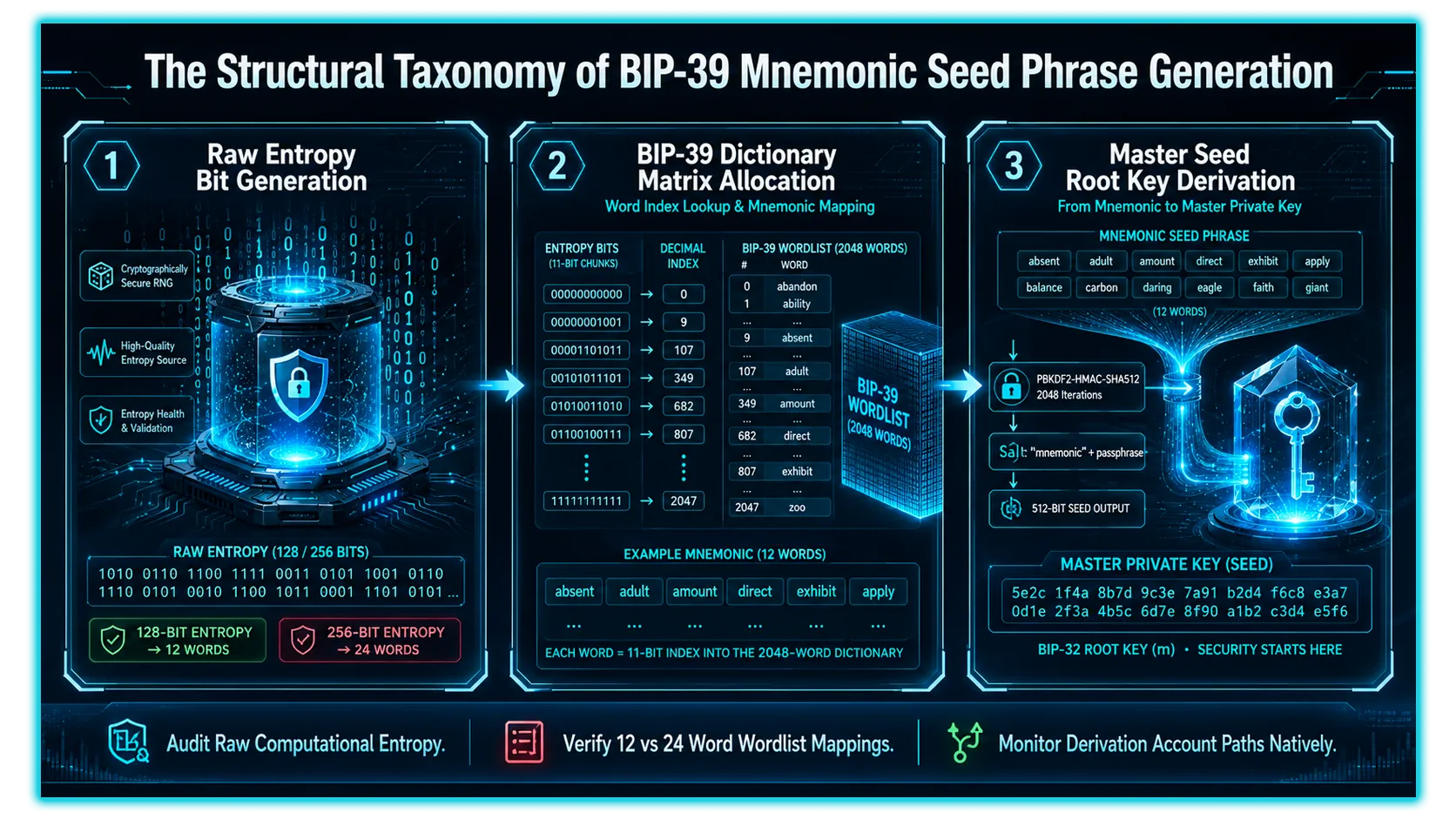
- To resolve this user-experience bottleneck, developers established Bitcoin Improvement Proposal 39 (BIP-39). The BIP-39 standard introduced a universal framework that translates raw mathematical randomness into a standardized sequence of simple, easily recorded words.
The Extraction of Entropy
The process begins w+ith your non-custodial software or hardware wallet generating a massive chunk of raw computational randomness, technically described as entropy. For a standard 12-word phrase, the system extracts 128 bits of entropy. For a highly secure 24-word phrase, the system generates a massive 256 bits of entropy. This sequence of random binary bits serves as the foundational DNA of your wallet.
The Checksum Guardrail
- To ensure that a user does not make an accidental typo when recording or re-entering their phrase later, the wallet passes the raw entropy through a SHA-256 cryptographic hashing function.
- The algorithm extracts a tiny piece of the resulting hash to serve as a built-in checksum. This checksum is appended directly to the end of the original entropy string. If you mistype a single character or swap the order of two words during a wallet restoration, the checksum will fail to calculate correctly, alerting you to the error before you broadcast a broken configuration.
The Wordlist Dictionary Mapping
- The combined string of entropy and checksum bits is split into uniform segments of 11 bits each. Each 11-bit segment represents a binary number that maps directly to an index position within the official BIP-39 wordlist. This dictionary consists of exactly 2048 carefully selected, English words. The words are specifically curated to ensure that no two words on the list sound identical or share similar letter structures (for example, every word can be uniquely identified by its first four letters alone).
- When you read your 12 or 24 words on your setup screen, you are looking at a human-readable map of an incredibly large binary number.
2. 12 Words vs. 24 Words: The Cryptographic Security Space Explained
A source of continuous debate across decentralized security communities centers on selecting the optimal phrase length: should you utilize a standard 12-word sequence or step up to an institutional 24-word configuration? Evaluating these two tracks requires looking at their overall mathematical security spaces.
The 12-Word Security Profile
- A 12-word phrase represents 128 bits of raw entropy. This means that an attacker attempting to guess or brute-force your phrase would have to choose from an astronomically large field of total possible combinations. To put this scale into perspective, the number of unique combinations hidden inside a 12-word phrase is roughly equal to thirty-four undecillion options: a number followed by thirty-six zeros.
- Even if a malicious actor grouped thousands of modern supercomputers together to guess millions of random phrases every second, it would still take them longer than the current age of the universe to successfully hit your exact combination. For standard retail users, a 12-word phrase provides an absolute security margin against random brute-force discovery.
The 24-Word Institutional Benchmark
A 24-word phrase raises the structural bar by processing 256 bits of raw entropy. The total number of unique combinations within a 24-word grid scales to a level that challenges human comprehension: a number followed by seventy-seven zeros. This level of cryptographic density is often described as "cosmic security." The energy required to simply run a computer array large enough to count through a 256-bit security space exceeds the total thermal output of our solar system.
The Practical Trade-off
- While a 24-word phrase is mathematically superior, it introduces an increased human-error surface area. Writing down, verifying, and safely storing 24 separate words doubles the chances of making a transcription error, misplacing a portion of a physical backup, or fumbling an emergency recovery window.
- Hardware wallet manufacturers take different approaches to this balance: some default strictly to 24 words to maintain maximum defense margins, while others support 12 words to optimize for human usability and lower transcription risks.
3. The Passphrase (The 25th Word): Constructing Hidden Accounts
- For advanced participants seeking an added layer of defense against physical coercion, home invasions, or key extraction attacks, the BIP-39 standard supports an optional security multiplier known as the Passphrase: frequently referred to as "the 13th word" or "the 25th word."
- It is critical to recognize that a passphrase does not function like a traditional app password. A standard password simply locks or unlocks access to a static account profile. A cryptographic passphrase, by contrast, acts as a core input parameter that completely alters the underlying mathematical derivation pipeline.
- The most flawless smart contract code and the tightest hardware wallet microchips mean very little if your master recovery phrase is stored unsafely. The vast majority of capital losses in self-custody environments do not occur because a malicious actor successfully cracked a protocol's math; they occur because users treat their seed phrases with casual disregard.
- To insulate your master key from environmental disasters, digital surveillance networks, and social engineering attacks, you must execute industrial-grade storage best practices.
The Digital Quarantine Rule
The absolute, non-negotiable rule of self-custody is that a seed phrase must never interact with a digital device under any circumstances.
The Vulnerability Matrix: Never take a digital photo of your recovery sheet, never type your words into a desktop text document, never save your phrase inside a cloud storage drive, and never paste your sequence into a private messaging application.
The Rationale: The exact millisecond your words pass through a keyboard or manifest on a screen connected to the internet, they are permanently exposed to keyloggers, automated cloud backup scraping tools, malicious browser extensions, and operating system vulnerabilities. Your recovery words should only be recorded using physical, analog tools.
Upgrading to Metal Backups
- Recording your recovery words on a standard piece of paper introduces a fragile single point of failure. A house fire, a broken water pipe, or simple physical deterioration over time can permanently erase your text.
- To achieve industrial-grade resilience, migrate your backup arrays to specialized Steel or Titanium Seed Storage Plates. These physical security tools allow you to punch, slide, or engrave your words directly into fireproof, waterproof, and chemical-resistant metal plates capable of surviving extreme structural collapses and temperatures exceeding 1000°C.
Geographic Sharding and Security Thresholds
For high-value capital pools, storing your entire recovery phrase on a single metal plate in your primary home introduces significant security vulnerabilities. If a bad actor accesses that single location, your entire financial network is compromised. Advanced allocators mitigate this risk through geographic distribution:
The Split Phrase Fallacy: A common amateur mistake is dividing a 12-word phrase into two halves (Words 1-6 and Words 7-12) and placing them in separate locations. If an attacker discovers the second sheet, they only need to guess 6 remaining words: a threshold that can be easily brute-forced by a consumer-grade laptop within minutes.
The Cryptographic Multi-Sig Alternative: Rather than physically cutting a single phrase into un-secured fractions, scale your security infrastructure by deploying a true on-chain Multi-Signature (Multi-Sig) architecture. By configuring a vault that requires approvals from 2 out of 3 completely separate hardware wallets (each secured by its own unique, independent seed phrase stored in separate geographic regions) you ensure that compromising a single physical location fails to grant an attacker access to your primary capital assets.
Seed Phrase Metric Comparison
| Metric Attribute | 12-Word Mnemonic | 24-Word Mnemonic |
| Entropy Weight | 128 Bits of Randomness | 256 Bits of Randomness |
| Unique Configurations | 34 Undecillion Combinations | 115 Quattuorvigintillion Combinations |
| Human Error Surface | Lower Transcript Risk | Higher Transcription Risk |
Physical Storage Hardening Tiers
| Hardening Tier | Storage Medium | Environmental Risk Profile |
| Tier 1: Minimal | Standard Archive Paper | High Fire and Water Vulnerability |
| Tier 2: Advanced | Marine-Grade Stainless Steel | Highly Fireproof and Waterproof |
| Tier 3: Elite | Multi-Sig Metal Shards | Maximum Physical Extortion Defense |
Integrating Telemetry Auditing via DEXTools
- As you secure your seed phrase storage and hardware wallet setup, maintaining visibility over decentralized markets remains essential. DEXTools provides advanced analytics to monitor live token behavior, liquidity pools, contract data, and market activity across public blockchain networks.
- With tools like Pair Explorer, Live New Pairs, Trade Story, Top Traders, and Big Swap Explorer, traders can audit volume trends, track whale movements, review liquidity depth, and check contract safety before interacting on-chain. This helps ensure secured wallets engage only with verified and liquid market venues while private keys remain safely protected offline.
You can access DEXTools here and start trading today!
Disclaimer: This article is for informational purposes only and does not constitute investment advice, financial advice, trading advice, or any other kind of advice. DEXTools does not recommend buying, selling, or holding any cryptocurrency or token. Users should conduct their own research and consult with a qualified financial advisor before making any investment decisions. Cryptocurrency investments are volatile and high-risk. DEXTools is not responsible for any losses incurred.
Frequently Asked Questions
What is a seed phrase?
A seed phrase is a series of words that can be used to recover a cryptocurrency wallet and access its associated funds. It acts as a master key to your digital assets.
How many words are typically in a seed phrase?
Seed phrases commonly consist of either 12 or 24 words. Both lengths offer strong security when properly managed.
What is the purpose of a seed phrase?
The primary purpose of a seed phrase is to provide a backup mechanism for your cryptocurrency wallet. If your device is lost or damaged, you can use the seed phrase to restore access to your funds on a new device.
Is a seed phrase the same as a private key?
No, a seed phrase is not the same as a private key. A seed phrase is a human-readable representation from which multiple private keys can be derived, while a private key directly controls access to specific cryptocurrency addresses.
What are best practices for securing a seed phrase?
Best practices include writing down your seed phrase physically and storing it in multiple secure, offline locations. Never store it digitally or share it with anyone.