The DEXTools Bias Audit: Check Your Thinking Before the Chart
— By Whatsertrade in Tutorials
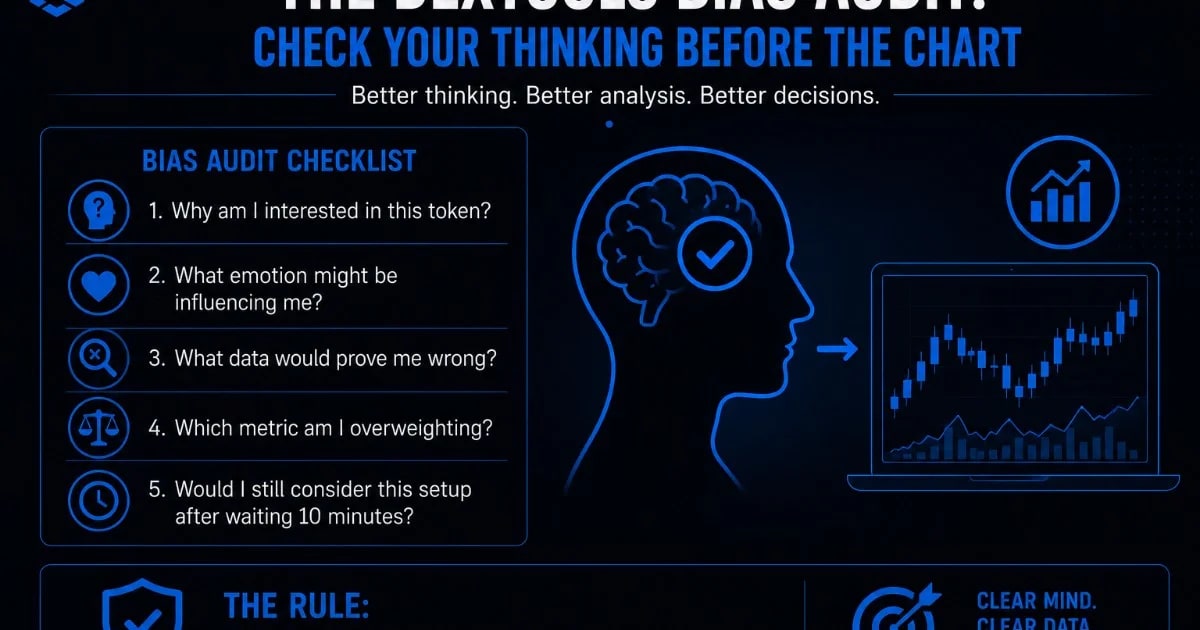
Learn how to use a DEXTools bias audit to reduce emotional trading, avoid confirmation bias, and make clearer crypto token research decisions.
Most crypto traders believe they are analyzing the market objectively. In reality, many traders make decisions before they realize it. A token looks exciting, a chart is moving, a social post creates urgency, and the trader starts looking for reasons to justify an entry.
Key Takeaways
This is where bias enters the process.
DEXTools gives traders access to liquidity, volume, holders, transactions, charts, and risk data. But even the best data can be misread when the trader is already emotionally attached to the outcome.
A DEXTools bias audit helps traders check their thinking before checking the chart. The goal is simple: reduce emotional interpretation and make better token research decisions.
What Is a Bias Audit?
A bias audit is a quick mental review before analyzing a token. It helps you identify whether your opinion is already being influenced by emotion, hype, fear, or social pressure.
Before opening a token chart, ask:
Am I looking for a real setup or just a reason to buy?
Did I discover this token through data or through hype?
Am I afraid of missing out?
Am I ignoring risk because the upside looks attractive?
Would I still be interested if the chart were not green?
These questions help you slow down before the market speeds you up.
Why Bias Matters in DEX Trading
DEX markets move quickly. New tokens can pump, dump, trend, and disappear within short periods. This speed makes bias more dangerous.
When traders feel urgency, they often skip important checks. They may ignore liquidity risk, overlook sell pressure, or assume that rising volume means real demand.
Bias does not always feel like emotion. Sometimes it feels like conviction. That is what makes it risky.
A bias audit creates distance between what you want to happen and what the data actually shows.
Bias 1: Confirmation Bias
Confirmation bias happens when you look only for information that supports what you already believe.
For example, you may see high volume and treat it as bullish, while ignoring low liquidity or heavy selling from large wallets.
Using DEXTools, confirmation bias often appears when traders focus on one positive metric and avoid the rest of the data.
To fight this bias, ask:
What data disagrees with my idea?
What would make this setup invalid?
Am I ignoring any warning signs?
A strong trade idea should survive criticism.
Bias 2: FOMO Bias
FOMO bias happens when traders feel pressure to enter because the token is already moving.
A fast chart can make traders believe that there is no time to think. But speed is not the same as quality.
Before entering, check:
Is the chart already overextended?
Is liquidity strong enough?
Are buyers still active?
Are large wallets selling into the move?
A token that already moved may still be interesting, but FOMO should never be the reason to enter.
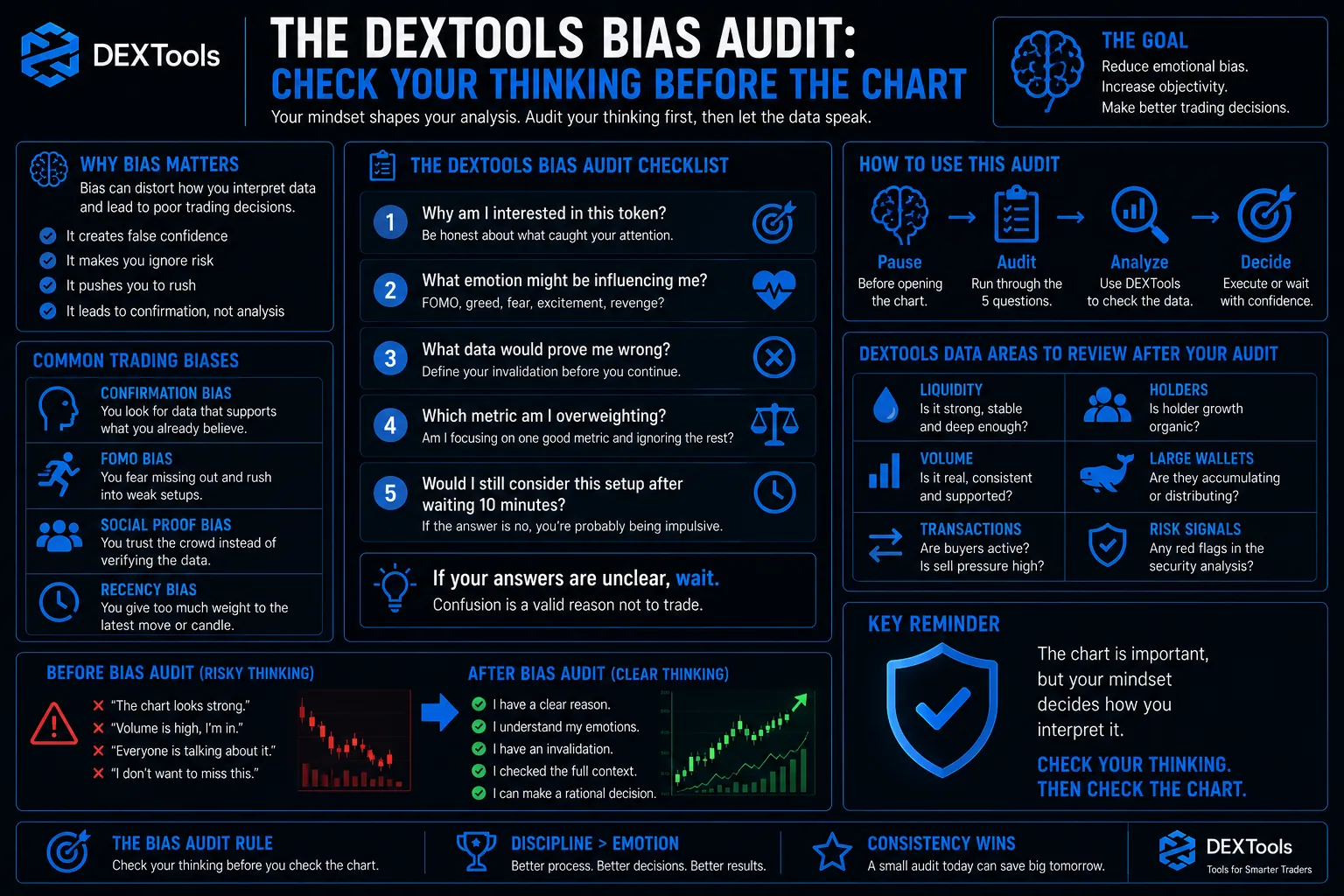
Bias 3: Social Proof Bias
Social proof bias happens when traders trust a token because many people are talking about it.
Community attention can matter, but social activity should not replace market data. A token can be popular and still have weak liquidity, poor distribution, or unstable volume.
Use DEXTools to test the hype.
Ask:
Does volume support the attention?
Are holders growing naturally?
Is the chart holding structure?
Are transactions healthy?
Social proof can help you discover tokens. It should not make the decision for you.
Bias 4: Recency Bias
Recency bias happens when traders give too much importance to the latest candle, latest post, or latest move.
A token that just pumped may feel stronger than it really is. A token that just dipped may look worse than it actually is.
To reduce recency bias, zoom out.
Review:
Recent trend.
Liquidity changes over time.
Holder growth over several periods.
Volume consistency.
Chart structure before the current move.
One moment does not define the whole setup.
How to Run a DEXTools Bias Audit
Before researching a token, answer these five questions:
Why am I interested in this token?
What emotion might be influencing me?
What data would prove me wrong?
Which metric am I overweighting?
Would I still consider this setup after waiting ten minutes?
If your answers are unclear, wait. Confusion is a valid reason not to trade.
The Bias Audit Rule
Use this simple rule:
“Check your thinking before you check the chart.”
The chart is important, but your mindset decides how you interpret it. If your thinking is biased, the data may only become a tool for justifying a weak decision.
Final Thoughts
DEXTools can help traders make better decisions, but only if traders use the data with a clear mind.
A bias audit helps reduce confirmation bias, FOMO, social pressure, and emotional decision making. It turns token research into a more disciplined process.
The best traders do not only analyze tokens. They analyze their own thinking first.
How to Review a Token Without Looking at Price First Why Real Time Data Matters for DEX Traders Community vs Hype: Spot Real Token Support New Token Risk Index: How Many New Tokens Have Real Liquidity