How to Build a “Maybe Later” List for Tokens That Are Not Ready Yet
— By Whatsertrade in Tutorials
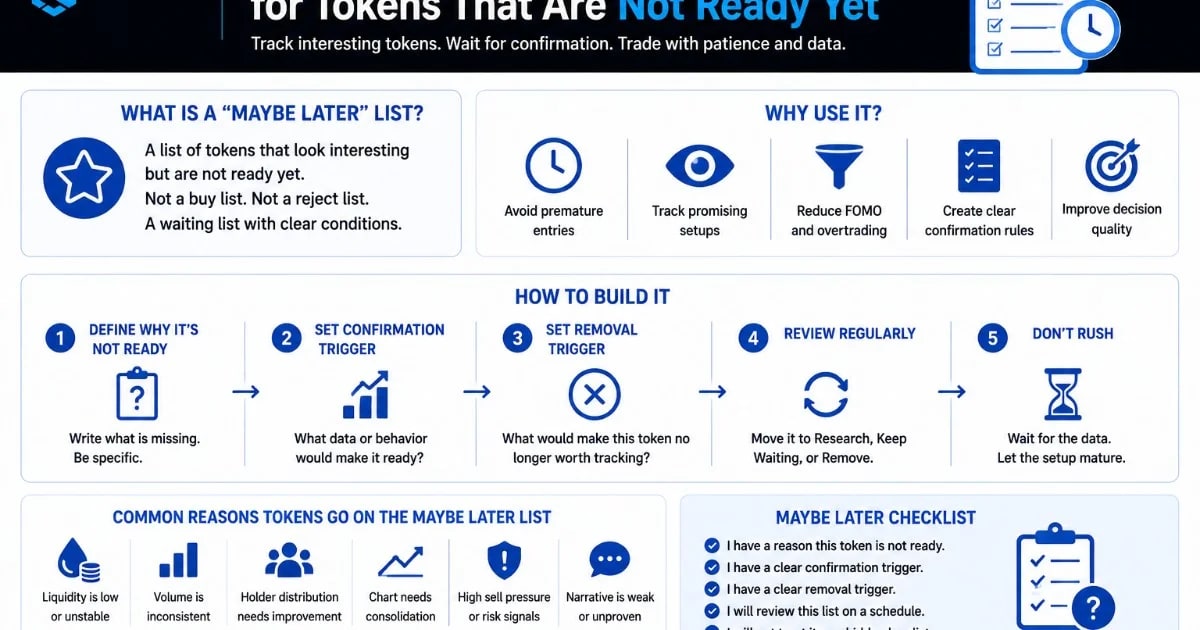
Learn how to build a Maybe Later list using DEXTools to track tokens that are interesting but not ready for deeper research or trading.
Not every token is a buy. Not every token is an avoid either.
Some tokens sit in the middle. They are interesting, but not ready. They may have early volume but weak structure. They may have a strong narrative but poor liquidity. They may have a promising chart but not enough confirmation.
This is where a “Maybe Later” list becomes useful.
A Maybe Later list is a place for tokens that deserve observation, not action. Using DEXTools, traders can track these tokens without rushing into weak entries.
What Is a Maybe Later List?
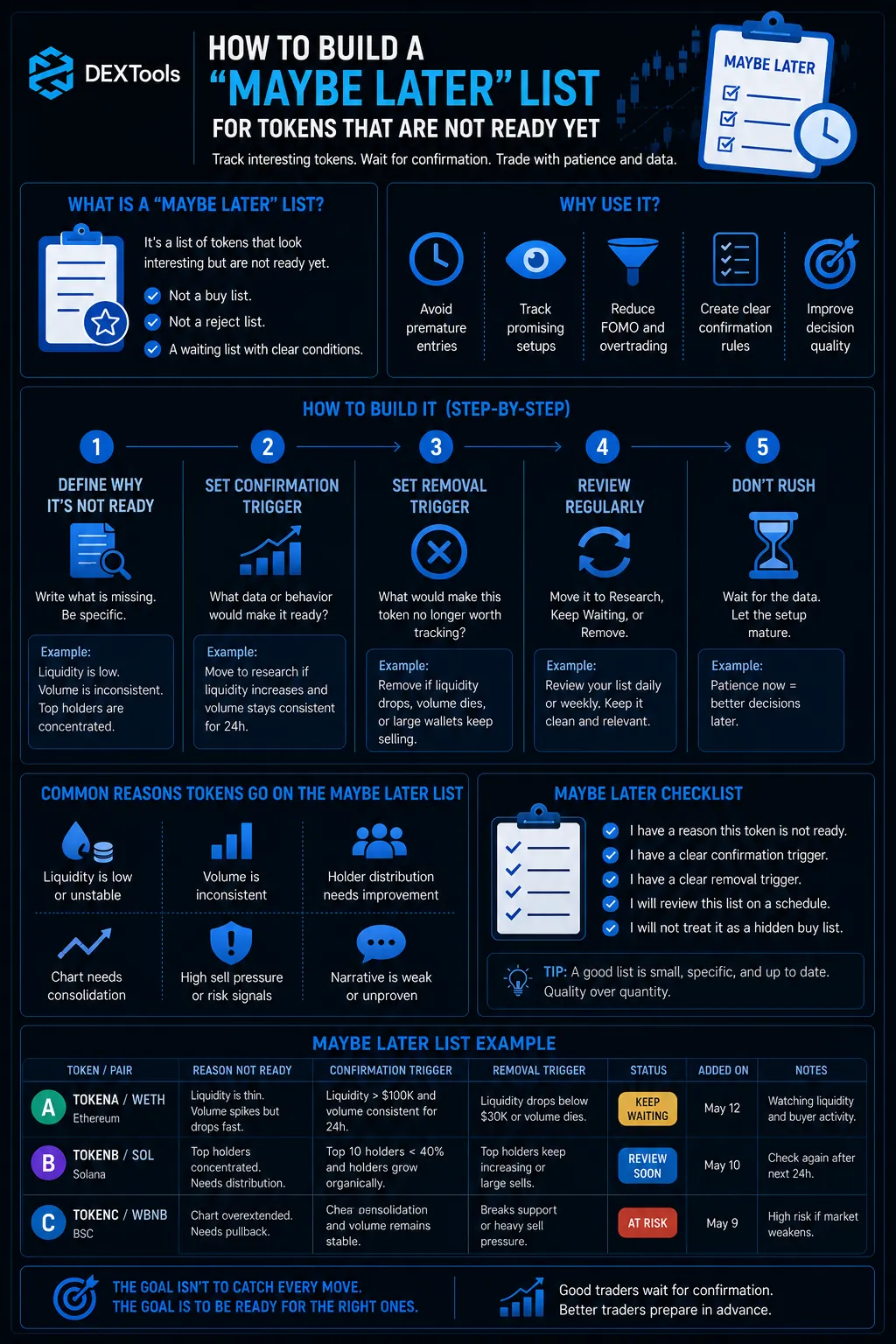
A Maybe Later list is different from a normal watchlist. A watchlist can include many tokens you follow. A Maybe Later list includes only tokens that are close to being interesting but still missing something important.
These tokens are not rejected. They are not approved. They are waiting for confirmation.
A token may enter this list because:
Liquidity needs to improve.
Volume needs to become more consistent.
Holder growth needs confirmation.
The chart needs consolidation.
Sell pressure needs to decrease.
The narrative needs stronger support.
The goal is patience with structure.
Why Traders Need This List
Many traders make poor decisions because they think every token must be classified as buy or avoid. But the market often gives incomplete information.
A Maybe Later list helps traders:
Avoid premature entries.
Track developing setups.
Reduce FOMO.
Create clear confirmation conditions.
Keep interesting tokens organized.
It gives traders a disciplined middle option.
Step 1: Define Why the Token Is Not Ready
Every token on the Maybe Later list needs a reason.
Do not add a token just because it looks interesting. Write what is missing.
Examples:
“Liquidity is improving but still too thin.”
“Volume is active, but buyers are not consistent.”
“Chart looks strong, but the move is overextended.”
“Holders are growing, but top wallet concentration is high.”
“Need lower sell pressure before considering deeper research.”
The reason should be specific.
Step 2: Set the Confirmation Trigger
A Maybe Later token should have a trigger that moves it forward.
Ask:
What would make this token worth deeper research?
What data needs to improve?
What risk needs to decrease?
What chart behavior would confirm strength?
Examples:
Move to deeper research if liquidity increases and remains stable.
Move to deeper research if volume stays consistent for 24 hours.
Move to deeper research if the chart consolidates instead of dumping.
Move to deeper research if holder distribution improves.
Without a trigger, the list becomes clutter.
Step 3: Set the Removal Trigger
A Maybe Later list also needs removal rules.
Ask:
What would make this token no longer worth tracking?
Examples:
Remove if liquidity drops sharply.
Remove if volume disappears.
Remove if the chart breaks structure.
Remove if large wallets keep selling.
Remove if the narrative fades.
A Maybe Later list should stay clean.
Step 4: Review the List Regularly
Review your Maybe Later list daily or weekly depending on your trading style.
Each token should move into one of three categories:
Research deeper.
Keep waiting.
Remove.
This prevents old ideas from staying alive longer than they should.
Step 5: Do Not Treat Maybe Later as a Hidden Buy Signal
The biggest mistake is treating the Maybe Later list as a soft buy list.
It is not.
A Maybe Later token still has unresolved issues. The list exists to prevent emotional action until the data improves.
If you enter before your confirmation trigger, you are not following the system.
Final Thoughts
A Maybe Later list gives traders a better way to handle incomplete setups. Instead of forcing a buy or avoid decision, traders can wait with clear conditions.
DEXTools helps traders monitor the data that matters: liquidity, volume, transactions, holders, chart structure, and risk signals.
Some tokens are not ready today. A good process helps you know what would make them ready tomorrow.
When DEXTools Signals Disagree: How to Make Sense of Conflicting Token Data Liquidity to Market Cap Ratio: Spotting Risky Tokens Locked Liquidity Is Not Enough: What Traders Still Need to Check Apparent Liquidity vs Executable Liquidity: Why a Large Pool Can Still Give You a Bad Entry