The “No Clear Driver” Rule: When a Token Move Does Not Make Sense
— By Whatsertrade in Tutorials
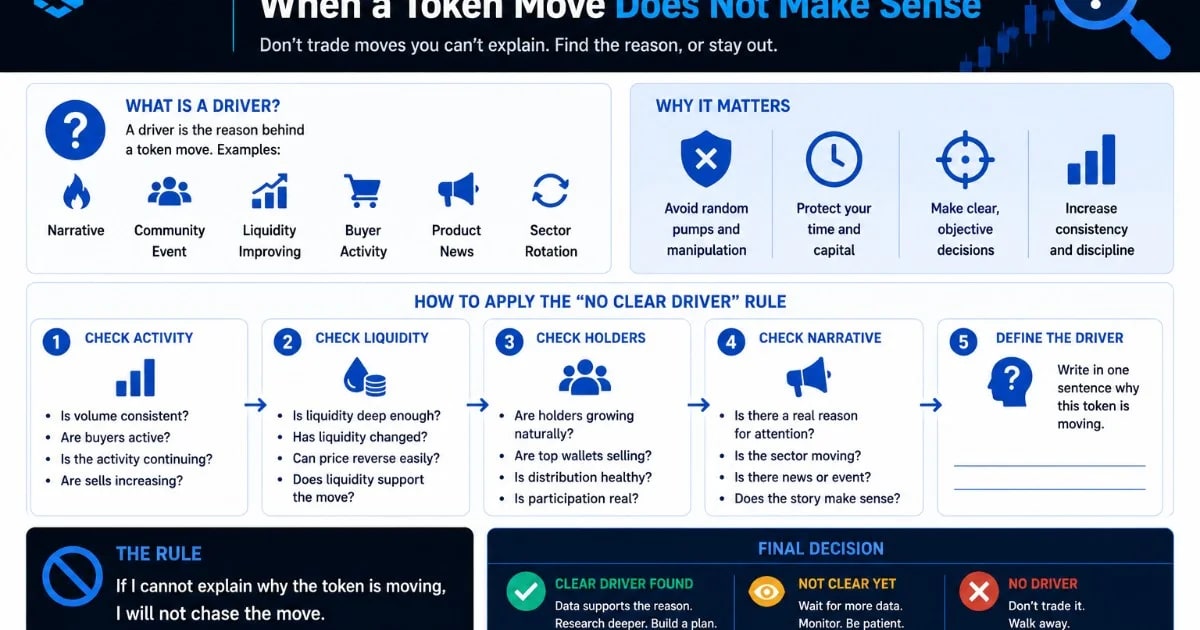
The No Clear Driver Rule: When a Crypto Token Move Makes No Sense Meta Description: Learn how to use the No Clear Driver Rule with DEXTools to avoid token moves that
A token can move fast without making sense. Price can pump, volume can spike, and traders can rush in before understanding why anything is happening.
In DEX markets, that can be dangerous.
The No Clear Driver Rule is simple: if you cannot identify what is driving the move, wait.
This does not mean every token needs a perfect explanation. But before entering, traders should understand whether the move is supported by data, narrative, liquidity, buyer activity, or some clear catalyst.
DEXTools helps traders investigate the move before reacting to it.
What Is a Market Driver?
A market driver is the reason traders are paying attention.
A driver can be:
A growing narrative.
Consistent buyer activity.
A community event.
A rotation into a sector.
A strong chart breakout supported by volume.
The driver explains why the token is moving.
Without a clear driver, the move may be noise.
Why No Clear Driver Is Risky
When a token moves without a clear driver, traders often create their own explanation.
They may say:
“Someone knows something.”
“The chart looks strong.”
“It must be early.”
“Volume is coming in.”
But assumptions are not analysis.
A move without a clear driver may fade quickly because there is no strong reason for buyers to keep supporting it.
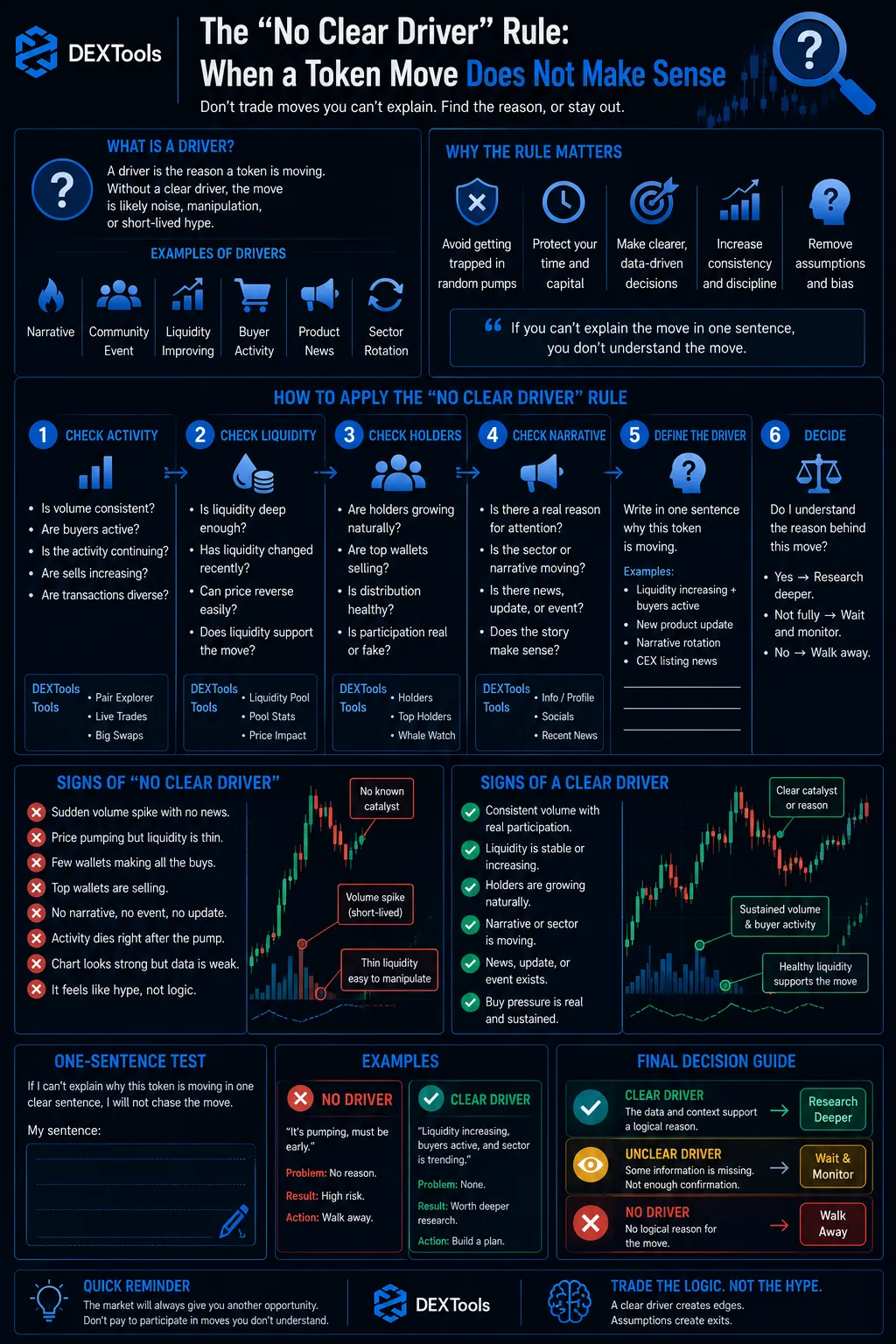
Step 1: Check Whether the Move Has Real Activity
Start with volume and transactions.
Ask:
Is volume consistent or sudden?
Are buyers active?
Are transactions diverse?
Are sells increasing?
Is activity continuing after the first spike?
If the move is based on one short burst of activity, the driver may be weak.
Step 2: Check Liquidity
A token can move strongly because liquidity is thin.
Ask:
Is liquidity deep enough?
Did liquidity change recently?
Does pool depth support the move?
Could the price reverse quickly?
If liquidity is weak, the move may be easier to create and easier to erase.
Step 3: Check Holder Behavior
Holder data can show whether participation is expanding.
Ask:
Are holders growing naturally?
Are large wallets buying or selling?
Are top holders too concentrated?
Is new participation meaningful?
If holders are not supporting the move, the driver may be temporary.
Step 4: Check the Narrative
A move may make more sense when connected to a broader market theme.
Ask:
Is this token part of an active narrative?
Are similar tokens moving?
Is the token gaining attention for a clear reason?
Is the story supported by data?
Narrative alone is not enough, but it can help explain why attention is arriving.
Step 5: Define the Driver in One Sentence
Before trading, write:
“This token is moving because…”
Examples:
“This token is moving because liquidity is increasing and buyers are active after a period of consolidation.”
“This token is moving because the sector is gaining attention and volume is confirming participation.”
If you cannot complete the sentence clearly, wait.
The No Clear Driver Rule
Use this rule:
“If I cannot explain why the token is moving, I will not chase the move.”
This protects traders from entering only because price is rising.
Final Thoughts
A token move without a clear driver can be exciting, but excitement is not enough. DEXTools helps traders test whether a move is supported by real data or only by temporary noise.
Before entering, check activity, liquidity, holders, chart structure, and narrative context.
If the move does not make sense, waiting is not weakness. It is discipline.
How to Separate Signal, Noise and Narrative in DEX Trading The No Bid Moment: When a DEX Token Has a Price but No Real Buyers Liquidity Rotation: How Capital Moves Between Tokens Inside the Same Narrative DEX Volume Recap: Liquidity Trends & Price Impact Insights