The Token Rejection Funnel: How to Eliminate Weak Setups Fast
— By Whatsertrade in Tutorials
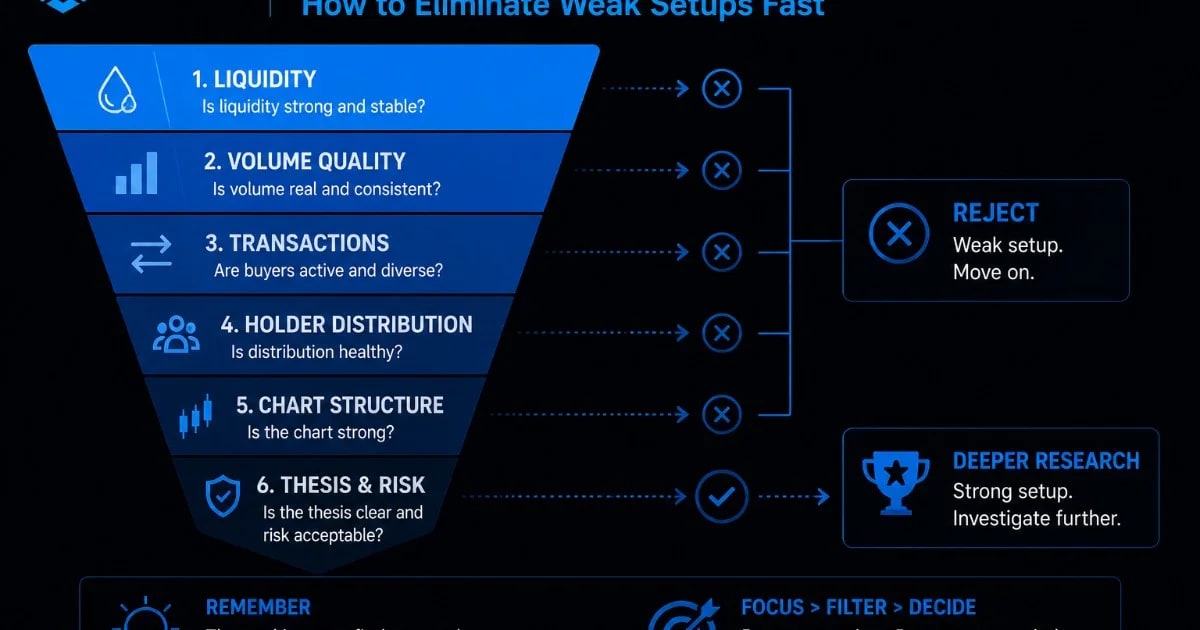
Learn how to use a token rejection funnel with DEXTools to filter weak crypto setups quickly before spending time on deeper research.
Most crypto traders spend too much time looking for reasons to buy. They open a chart, see a token moving, and start searching for confirmation. But in DEX markets, the faster skill is often the opposite: knowing how to reject weak setups before they consume your attention.
The Token Rejection Funnel is a simple framework for filtering tokens quickly. It helps traders decide whether a token deserves deeper research or should be removed from consideration.
Using DEXTools, traders can review liquidity, volume, transactions, holders, chart structure, and risk signals to eliminate weak setups fast.
Why Rejection Matters in DEX Trading
DEX markets are full of new pairs, short lived pumps, recycled narratives, and low quality setups. Not every token deserves your time.
A rejection funnel helps you:
Save research time.
Avoid emotional trades.
Reduce exposure to weak liquidity.
Focus on stronger opportunities.
Build discipline before entering.
The goal is not to find the perfect trade in seconds. The goal is to remove obvious weak candidates before they reach your shortlist.
Funnel Step 1: Reject Weak Liquidity
Liquidity is the first filter. If liquidity is too thin, unstable, or clearly insufficient for the token’s activity, the setup may not deserve more time.
Ask:
Is liquidity deep enough for real trading?
Has liquidity changed suddenly?
Would a normal sell create major slippage?
Does liquidity match the current volume?
If the answer is poor, reject the token or move it to a low priority list.
Weak liquidity can make entry easy and exit painful.
Funnel Step 2: Reject Low Quality Volume
Volume can attract attention, but volume alone is not enough.
Reject or downgrade tokens where volume appears high but lacks quality. This can happen when a few wallets generate most of the activity, when sells dominate, or when volume spikes without follow through.
Ask:
Is volume consistent?
Are many wallets participating?
Are buyers active?
Does volume continue after the first move?
Is volume supported by liquidity?
If volume looks noisy or unsupported, the setup may be weak.
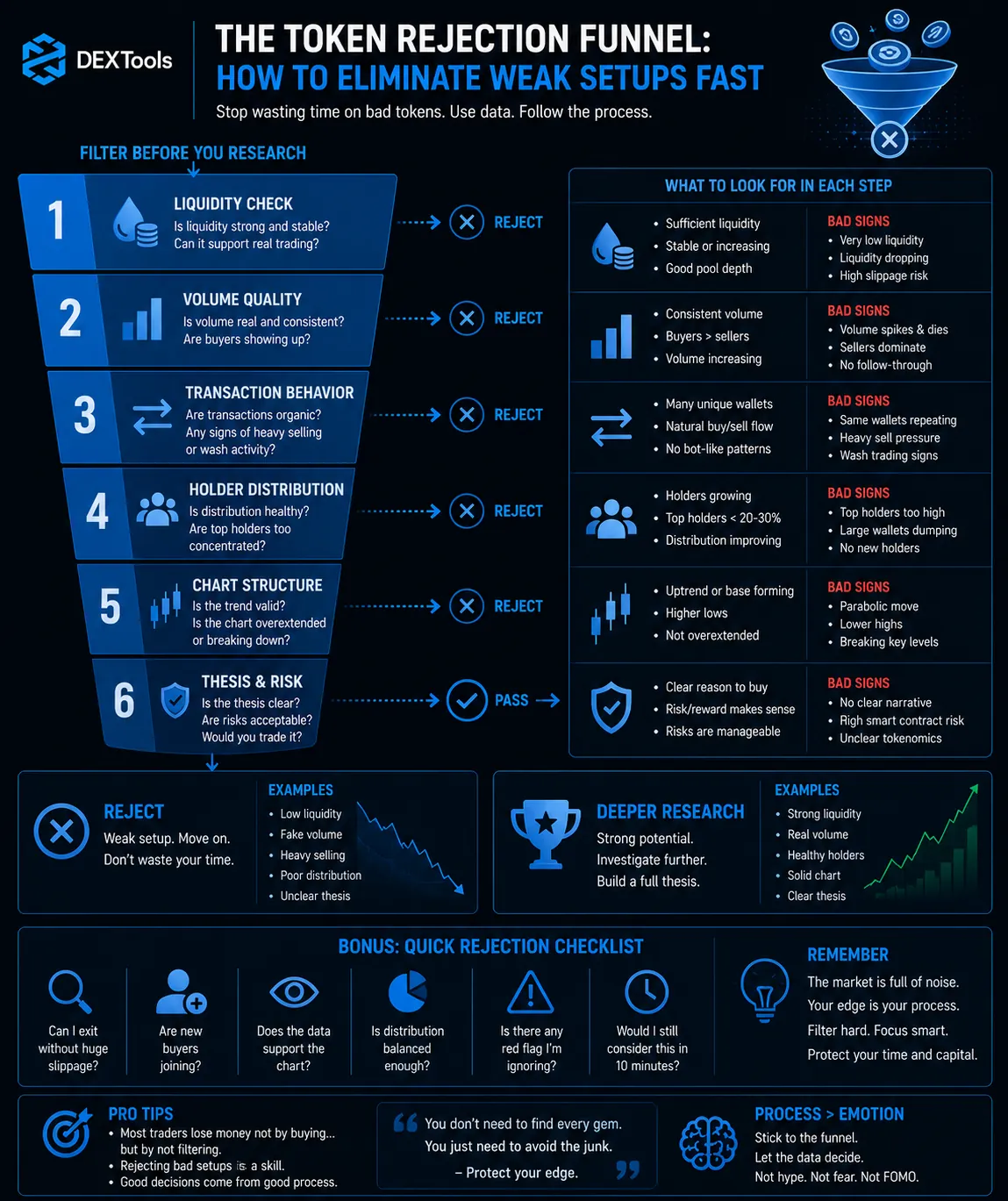
Funnel Step 3: Reject Suspicious Transaction Behavior
The transaction feed can reveal what the chart hides.
Look for repeated activity from the same wallets, heavy sell pressure, large wallets exiting, or unnatural buy and sell patterns.
Ask:
Are transactions diverse?
Are large wallets selling into buyers?
Are buys becoming smaller?
Are sells increasing?
Does the activity look organic?
If transaction behavior looks unhealthy, reject the setup or wait for better evidence.
Funnel Step 4: Reject Poor Distribution
Holder data helps traders understand concentration risk.
A token may look active, but if too much supply is controlled by a few wallets, the setup can become fragile.
Ask:
Are top holders too concentrated?
Are holders growing naturally?
Are large wallets accumulating or distributing?
Is new holder growth meaningful?
If holder distribution creates serious risk, the token should not pass the funnel.
Funnel Step 5: Reject Broken Chart Structure
The chart should be reviewed after the data, not before it.
Reject tokens where the chart is already overextended, breaking structure, or failing to hold key areas.
Ask:
Has the token already moved too far?
Are pullbacks controlled?
Is the trend still valid?
Is price making lower highs?
Is the chart supported by volume?
A beautiful candle does not matter if the structure is weak.
Funnel Step 6: Reject Unclear Theses
If you cannot explain why the token is interesting, reject or pause.
A clear thesis might include improving liquidity, consistent volume, healthy holders, and strong chart structure. A weak thesis sounds like hope, hype, or FOMO.
Ask:
Why does this token deserve attention?
What data supports the idea?
What could prove me wrong?
What is the main risk?
If the answer is unclear, wait.
Final Thoughts
The Token Rejection Funnel helps traders protect their attention. Instead of analyzing every token deeply, traders can eliminate weak setups quickly and focus on better candidates.
DEXTools provides the data. The funnel provides the discipline.
In DEX trading, rejecting bad setups is not wasted time. It is one of the fastest ways to improve decision quality.
New Token Risk Index: How Many New Tokens Have Real Liquidity Apparent Liquidity vs Executable Liquidity: Why a Large Pool Can Still Give You a Bad Entry Liquidity Velocity: Why Fast LP Changes Matter More Than Total Liquidity How to Build a No-Trade List Using DEXTools