The One-Page Token Memo: How to Summarize a DEXTools Setup Before Entering
— By Whatsertrade in Tutorials

Enhance your trading strategy with a one-page memo to assess risks and define your thesis before entering trades. Improve your decision-making process.
Most traders collect information quickly, but they rarely organize it before entering a trade. They check the chart, glance at liquidity, look at volume, scan holders, then make a decision based on memory and emotion.
A one-page token memo solves this problem.
Key Takeaways
The idea is simple: before entering a trade, summarize the token setup in one clear page. This forces you to slow down, define your thesis, identify risks, and decide whether the trade still makes sense.
DEXTools provides the data. The token memo turns that data into a structured decision.
Why Use a Token Memo?
A token memo helps traders avoid impulsive decisions. It creates a written record of why a token looked interesting and what risks were visible before entry.
This is useful for three reasons.
First, it improves decision quality. You cannot hide from weak data when you write it down.
Second, it helps with trade review. After the trade, you can compare your original thesis with what actually happened.
Third, it reduces emotional trading. A memo creates distance between excitement and execution.
Section 1: Basic Token Information
Start with the basics.
Token name:
Ticker:
Pair:
Chain:
DEX:
Current price:
Market cap or valuation estimate:
Liquidity:
Age of pair:
This section gives context. A new low-liquidity token should not be judged the same way as an older token with deeper liquidity and longer trading history.
Section 2: The Trading Thesis
Write one short paragraph explaining why the token is interesting.
For example:
“This token is interesting because it belongs to a growing narrative, liquidity is stable, holder growth is increasing, and the chart is forming a controlled continuation pattern.”
The thesis should be specific. Avoid vague statements like “It looks bullish” or “The community is strong.”
A good thesis explains what the data shows and why that matters.
Section 3: Liquidity Review
Liquidity is one of the most important parts of the memo.
Include:
Total liquidity.
Liquidity trend.
Liquidity lock status if available.
Slippage concerns.
Recent liquidity changes.
Then write a simple conclusion:
Liquidity status: strong, acceptable, weak, or risky.
This helps you understand whether the trade is easy to exit or only easy to enter.
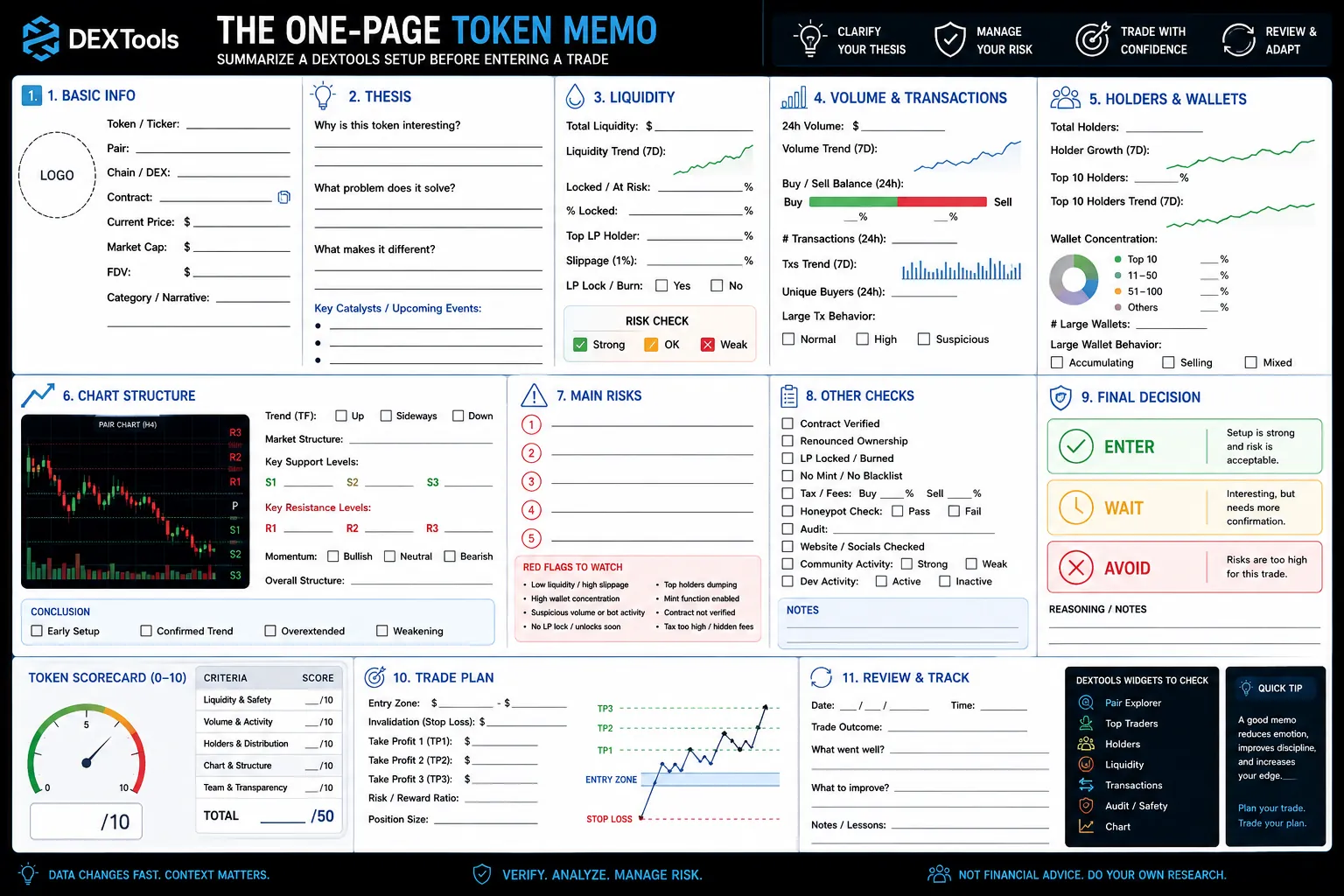
Section 4: Volume and Transaction Review
Next, summarize activity.
Include:
24h volume.
Recent volume trend.
Buy and sell balance.
Unique buyer activity.
Large transaction behavior.
Transaction quality matters more than raw activity. A token with many small organic trades may be healthier than a token with a few suspicious large spikes.
Write a conclusion:
Activity status: organic, speculative, weak, or suspicious.
Section 5: Holder and Wallet Review
Holder data can help identify distribution risk.
Include:
Total holders.
Holder growth trend.
Top holder concentration.
Large wallet behavior.
Signs of accumulation or distribution.
Then write:
Distribution status: healthy, concentrated, improving, or risky.
This section helps you avoid tokens where a few wallets control too much of the outcome.
Section 6: Chart Structure
The chart section should be simple and practical.
Include:
Current trend.
Support and resistance areas.
Recent pullbacks.
Momentum strength.
Whether the chart is early, extended, or consolidating.
Write:
Chart status: early setup, confirmed trend, overextended, or weakening.
This prevents buying only because the last candle is green.
Section 7: Main Risks
Every memo should include a risk section. If you cannot name the risks, you have not researched enough.
Examples:
Low liquidity.
Heavy sell pressure.
Overextended chart.
Holder concentration.
Weak follow-through.
Narrative fading.
Risky contract signals.
Large wallets selling.
Write the top three risks clearly.
Section 8: Final Decision
End the memo with one of three decisions:
Enter: The setup is strong enough and risk is acceptable.
Wait: The setup is interesting but needs confirmation.
Avoid: The risks are too high.
Add one sentence explaining the decision.
For example:
“Decision: Wait. The token has strong volume, but liquidity is weak and large wallets are selling into the move.”
Final Thoughts
A one-page token memo turns DEXTools data into a clear trading process. It helps traders move from scattered observations to structured decisions.
The goal is not to create a perfect prediction. The goal is to understand what you are buying, why you are buying it, and what could go wrong.
In fast markets, clarity is an edge. A token memo gives traders that clarity before capital is at risk.
When DEXTools Signals Disagree: How to Make Sense of Conflicting Token Data Locked Liquidity Is Not Enough: What Traders Still Need to Check Fake Market Cap vs Real Exit Liquidity: Why the Number Can Mislead Traders When Not to Trade: 12 Red Flags Every DeFi Trader Should Know