How to Build a False Positive Library From Failed Token Setups
— By Whatsertrade in Tutorials
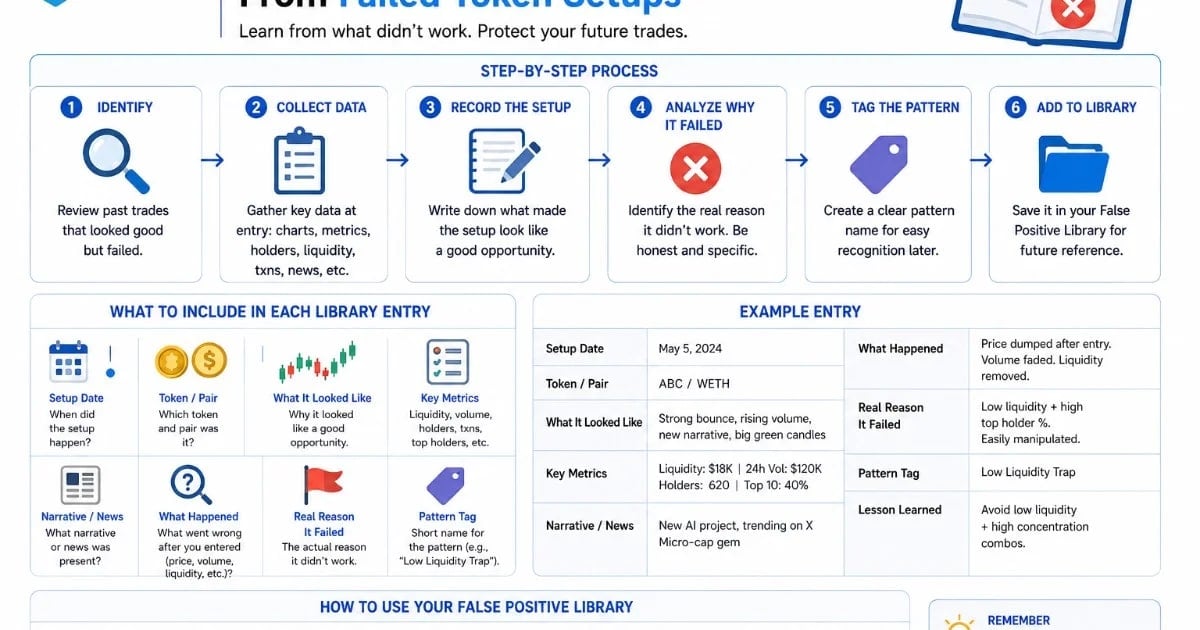
Learn how to build a false positive library using DEXTools to study failed crypto setups and improve your token research process.
Some token setups look good at first and fail later. They show high volume, rising holders, a clean chart, or strong social attention. Traders enter, but the setup breaks down.
These are false positives.
A false positive library is a collection of setups that appeared strong but did not work. By studying them, traders can learn which signals were misleading and how to improve future research.
DEXTools is useful not only for finding active tokens, but also for studying failed ones.
What Is a False Positive?
A false positive is a signal that looks bullish but does not lead to a strong outcome.
Examples:
High volume that fades quickly.
Rising holders with poor distribution.
A clean breakout with no follow through.
Social hype without buyer support.
Liquidity that improves briefly and then weakens.
A chart that looks strong while large wallets sell.
False positives are valuable because they reveal how weak setups can disguise themselves.
Why Build a Library?
Most traders remember big wins and painful losses. Fewer traders study setups that almost worked or looked good but failed.
A false positive library helps traders:
Improve pattern recognition.
Avoid repeated mistakes.
Identify misleading signals.
Build better rejection rules.
Reduce emotional confidence.
Over time, it becomes a personal database of lessons.
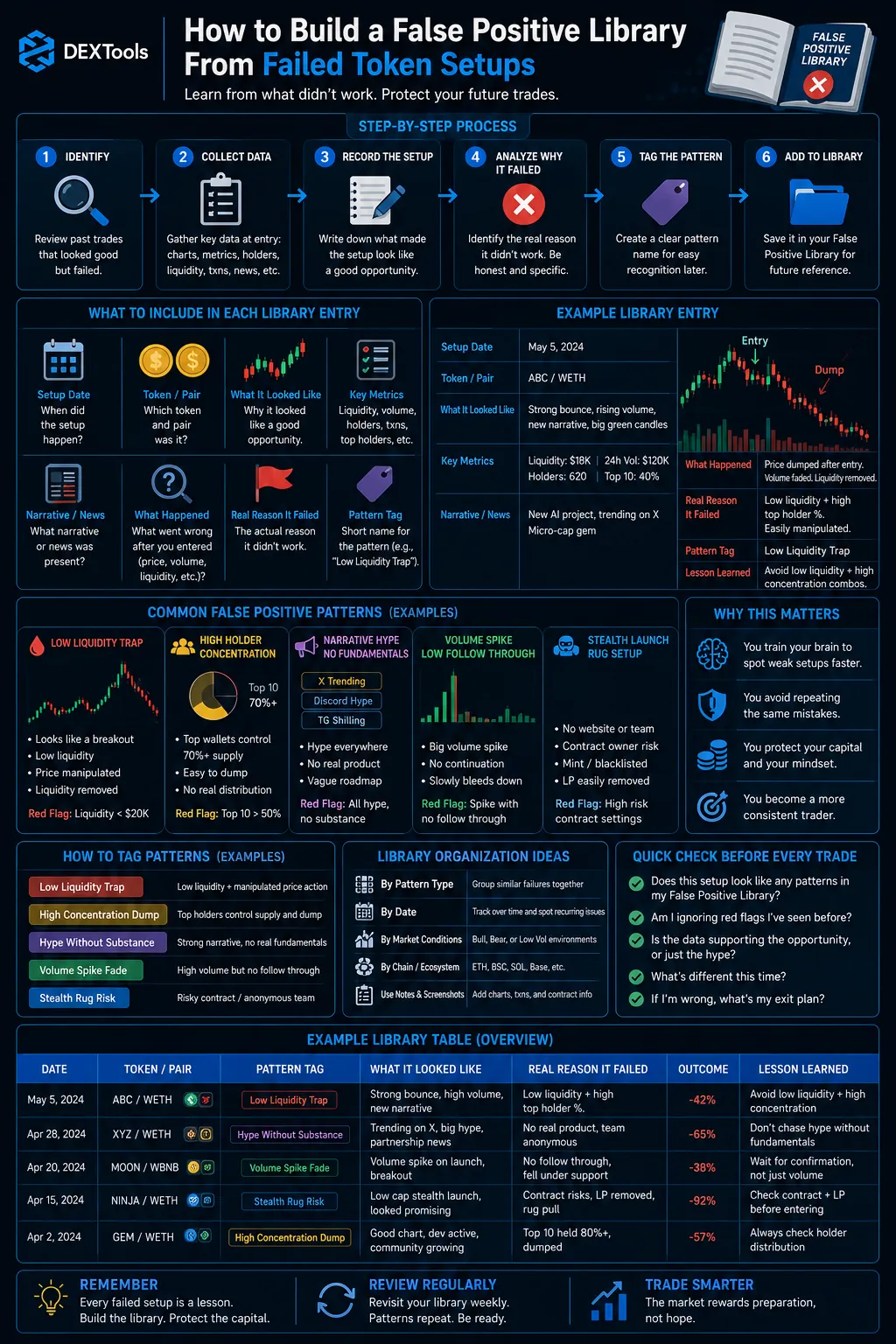
Step 1: Save the Setup
When a token fails after looking interesting, save it.
Record:
Token name and pair.
Date reviewed.
Reason it looked interesting.
Main positive signal.
Main risk ignored.
What happened afterward.
This does not need to be complicated. The goal is to preserve the lesson.
Step 2: Identify the Signal That Fooled You
Ask:
What made this setup look good?
Was it volume?
Holder growth?
A clean chart?
A narrative?
A large buy?
A trending position?
Then ask whether that signal had real support from other data.
Step 3: Find the Missing Confirmation
Most false positives fail because one signal looked strong while other data was weak.
Ask:
Was liquidity strong enough?
Did volume continue?
Were transactions healthy?
Were holders distributed well?
Did the chart hold structure?
Were there risk warnings?
The missing confirmation is often the lesson.
Step 4: Write the New Rule
Turn every false positive into a rule.
Example:
“If volume spikes but liquidity does not improve, I will not treat the move as strong.”
Another example:
“If a clean chart appears while top wallets are selling, I will wait.”
Rules make your library useful.
Step 5: Review the Library Monthly
A false positive library becomes more powerful over time.
Review it monthly and ask:
Which signals fooled me most often?
Which risks did I ignore?
Which setups failed in similar ways?
What rule should I add to my process?
This turns mistakes into structure.
Final Thoughts
A false positive library helps traders learn from setups that looked good but failed. Instead of forgetting them, traders can study the signals that misled them.
DEXTools makes this process easier by giving access to charts, liquidity, holders, transactions, and risk data.
Every false positive contains a lesson. Write it down before the market repeats it.
The Token Rejection Funnel: How to Eliminate Weak Setups Fast Fake Holders vs Real Buyers: How Wallet Count Can Mislead Traders Pool Chart Divergence: When the Candle Looks Bullish but the Liquidity Says No Holder Inflation: Why More Wallets Does Not Always Mean More Believers